Posts

A tale of two Christmas pageants: Bethlehem’s angels and General Washington’s weary soldiers

“Wow! Someday I want to be in that Christmas pageant too! I wanna play the part of Joseph, or one of those kings bearing gifts, or a shepherd hearing from angels!” That's what I said as a small child thrilled with the wonderful sights and sounds of the big Christmas pageant at our church school. But it didn't turn out quite like I had wanted. Each year those main character parts were handed out to others, and my role was to simply sing in the children’s choir—a group of small white-shirted messengers of God, proclaiming the birth of a Savior named Jesus. Now don’t get me wrong, I’ve always loved singing, but wouldn’t it have been neat to wear a shiny crown and a colorful robe as one of the wise men from the East bearing gifts for the newborn King? Finally one year I landed a speaking part (seven whole words!), but instead of the regular pageant with angels and wise men and shepherds, this time it was for a most unusual little production. We enacted parts of the true story ...
The Trinity: the grammar of divine love

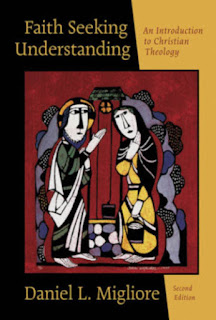
This post continues a series reviewing Daniel Migliore's book,  Faith Seeking Understanding, An Introduction to Christian Theology . For other posts in this series, click a number:  1 ,  2 ,  3 ,  5 . Migliore speaks of trinitarian faith as giving us a "grammar of wondrous divine love that freely gives of itself to others and creates community, mutuality, and shared life" (p76). He summarizes this grammar with three statements (what follows compiles quotes from pages 76-82): 1. To confess that God is triune is to affirm that the eternal life of God is personal life in relationship . In God's eternal being there is movement, life, personal relationship and the giving and receiving of love.  God is one, but the unity of God is a living unity - a koinonia of persons in love. The three persons of the Trinity have their personal identity in relationship. In this oneness, there is differentiation and otherness, for relationship presupposes otherness...

Advent - the creative act of the Spirit in Mary and the Son – the beginning of the future

This post was contributed by worship leader Mike Hale. According to Matthew and Luke, and as testified in the creeds of the Church, it is in relation to Mary, the mother of Jesus, that the Holy Spirit begins to be revealed in his New Testament fullness. Tom Smail writes in The Giving Gift: The Holy Spirit in Person , Of course when the Creed brings the Holy Spirit and Mary together, the subject of the sentence is not either of them, but ‘Jesus Christ, his only Son our Lord, who was conceived by the Holy Spirit and born of the virgin Mary’. If the Spirit works revealingly in Mary, it is not for her sake or yet for his own, but so that Jesus Christ can be formed in her and born from her. Mary’s response is not to the Holy Spirit as such but to the promise about Jesus that is made to her (Luke 2:26-38). The Christological concentration is central from the start…. (Page 22). To paraphrase Smail, we can think of Mary as the model charismatic—and the primary gift the Spirit gave to her w...

Christmas celebrates our redemption

Image
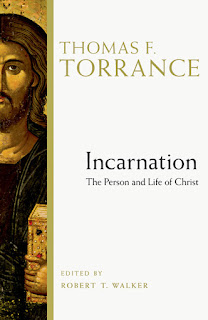
[Updated 12/25/2016] At Christmas, we celebrate the Incarnation---the stunning miracle by which the eternal Son of God, while not ceasing to be fully God, became fully human in the person of Jesus Christ. As noted by Thomas F. (T.F.) Torrance in the book  Incarnation, the Person and Life of Christ , the Incarnation is a "redeeming event" by which the Son of God assumed "our unholy humanity" with the result being that, "his purity wipes away our impurity, his holiness covers our corruption" (p82). This association of the Incarnation with our redemption is often overlooked at Christmas; yet it is central to the Christmas story. As T.F. notes, through the Incarnation, God, in the person of Jesus, permanently united our human nature with his divine nature. The result of this union (which includes us in Jesus' birth, life, death, resurrection and ascension), is that humanity is given to share in the righteousness of Jesus: "Not only the ne...

A gospel-centered doctrine of the Trinity

Image
This post continues a series reviewing Daniel Migliore's book,  Faith Seeking Understanding, An Introduction to Christian Theology . For other posts in this series, click a number:  1 ,  2 ,  4 ,  5 . "The  Trinity"  by Andrei  Rublev, c. 1401 The task of Christian theology is to clarify an understanding of God that is appropriate to and fully congruent with the message of the gospel of Jesus Christ. According to Daniel Migliore in  Faith Seeking Understanding , that is precisely what the historic doctrine of the Trinity accomplishes: The doctrine of the Trinity...is the product of the meditation and reflection of the church on the gospel message over many centuries. In other words, the starting point or root of trinitarian faith is the good news of the love of God in Christ that continues to work in the world by the Holy Spirit. The doctrine of the Trinity is the church's effort to give coherent expression to this mystery ...

A most welcome Trinitarian Advent song from Phil Keaggy

Image
This post was contributed by worship leader Mike Hale. For additional posts from Mike, click here . With a more limited budget this year, I hadn’t planned on adding to my collection of Christmas music—that is, until Welcome Inn: a Phil Keaggy Christmas , caught my eye at the Fuller Seminary bookstore. Having witnessed several of Keaggy’s virtuoso performances first-hand, he’s a favorite of mine. His guitar playing is legendary, and he’s also a talented singer-songwriter (often said to sound a bit like Paul McCartney), so I couldn’t wait to hear this latest mostly original vocal/acoustic Christmas package (“In the Bleak Mid-Winter” and “Shades of Green and Red” are the only two instrumentals). Surprise number one —my favorite of Phil’s originals on this CD isn’t a guitar-driven song. It’s the beautiful piano-based ballad “Father,” a reflective and worshipful song pointing to the love of the Triune God, and the roles of Father, Son and Holy Spirit in the story of the coming of the long...

Migliore's doctrine of Holy Scripture

Image
Daniel Migliore This post continues a series reviewing Daniel Migliore's book  Faith Seeking Understanding: An Introduction to Christian Theology .   For other posts in this series, click a number:  1 ,  3 ,  4 ,  5 . Migliore helpfully sets out a Trinitarian doctrine of Holy Scripture for the church. Here are excerpts: As long as the church remains faithful to the self-communication of the triune God, it will acknowledge the priority and authority of the scriptural witness in its life and mission. At the same time, the real humanity of the biblical witnesses will also be recognized without apology or embarrassment. It is not a weakness but a strength of the Christian understanding of revelation that its original witnesses are unmistakably historically conditioned and remarkably diverse human beings. That we have the treasure of the gospel in clay jars ( 2 Cor. 4:7 ) is as true of Scripture as it is of all subsequent Christian witness based on Scr...

Faith Seeking Understanding

Image
This is the first post in a series reviewing Daniel Migliore's book  Faith Seeking Understanding: An Introduction to Christian Theology . For other posts in this series, click a number:  2 ,  3 ,  4 ,  5 . To my knowledge, this is one of the best systematic theologies written from a fully Trinitarian, incarnational perspective - what Migliore calls "The fullness of trinitarian faith and its relational understanding of God, creation, reconciliation, and consummation" (pxii). For Migliore, to participate as a community of faith in the task of systematic theology, is to ask four basic questions (pp11-15): What is the gospel?  Are the proclamation and practice of the community of faith true to the revelation of God in Jesus Christ as attested in Scripture? What is the whole gospel?  Do the proclamation and practice of the community of faith give adequate expression to the whole truth of the revelation of God in Jesus Christ? What is the p...

A Trinitarian statement of faith

Image
David Torrance Pastor David W. Torrance, the younger brother of theologians Thomas F. and James B. Torrance teaches and preaches in accordance with the incarnational Trinitarian he learned from Karl Barth and that he shares with his brothers and their many students. For a You're Included interview with David,  click here . Following is the  statement of faith that was   posted   on David's website (now closed). Note how it emphasizes the finished work of Christ, and then speaks to our response as "heart-felt gratitude" by which we accept our salvation in Christ. As Christians we live by the faith of the Son of God. We are redeemed not by our faith but by Christ’s faith. We are called simply to look up and thank him. Our heart-felt gratitude is our acceptance of his salvation. No matter who we are, we are surrounded and embraced by God’s love. We live under the waterfall of his continuing forgiveness for all our sins, past, present and future. For God has...

How can a loving God be a God of wrath?

Image
[Updated 6/6/2020] In Romans 1:18, Paul declares that, "The wrath of God is being revealed from heaven against all the godlessness and wickedness of men who suppress the truth by their wickedness." But how can a loving God be a God of wrath? The answer is that God's wrath, like all his attributes, is an expression of his being (essence), which is love (1 John 4:8). This post explains. (public domain via Wikimedia Commons) God, being in his essence love, loves us (God does what God is). And God finds the evil that hurts his beloved children to be intolerable, and so, in wrath, he judges that evil. What Paul is telling us in Romans is that God has already accomplished this judgment through the life, death, resurrection and ascension of his incarnate Son, Jesus Christ. In and through Jesus, God poured out his wrath on all sin, all evil. Through Jesus, God's wrath is ended - the enmity humanity created between itself and God through sin, is ended. Indeed, Go...

This Thanksgiving, give thanks as a Christian

This post was contributed by worship leader Mike Hale. [Following is an excerpt from an article by Matt Royal. You can read Matt’s entire article Giving Thanks as a Christian ,  in the Nov. 8, 2010 issue of The Adopted Life .  The same issue includes an excellent article on Advent by Jonathan Stepp, titled The Womb of the Incarnation .] The act of thanksgiving centers us, stabilizes us, and reinforces the truth of our place of dependence in this universe. When we as Christians give thanks to our God, we are not just giving thanks to the source of all blessings. We are giving thanks to a God who knows us and who shares his life with us in a personal way. We give thanks to the one true God who is (and always has been) all about person-to-person relationships. We give thanks to a God who is not a simple individual, but a community. He is the Trinity—one God who is Father, and Son, and Holy Spirit. In our God the sharing of life and love has always been who he is, and out of ...

Lord’s Prayer - Part 4: The Spirit-filled forgiven community is a forgiving community

In The Forgotten Father , by Thomas A. Smail, the author suggests that with the particular placement of petition for pardon (“Forgive us our sins”) Jesus teaches his disciples that we are to make such petition only after we have already praised the Father, exposed ourselves to the call and grace of his kingdom, set ourselves within the generosity of his provision for us” that we can and must see the wrongness of our present response to him and have recourse to his cleansing and forgiveness (p. 166). [Valuable advice for pastors, worship planners and worship leaders, in designing and carrying out worship services.] To bypass the clear priorities of these earlier parts of the Lord’s prayer (Luke 11:1-4), and to immediately rush to request pardon can lead to a “guilt-ridden religion that is obsessed with its sins and unworthiness.” Smail also reminds the people of God of the social consequences of the gospel of forgiveness – that it is not merely an “individualistic inner transaction wit...

Lord’s Prayer, Part 3 - Praying for the kingdom that keeps on coming, and heavenly bread for the great Tomorrow

This post was contributed by worship leader Mike Hale. Continuing with our study of the Lord’s Prayer from The Forgotten Father , by Thomas Smail – After having taught his disciples to praise the Father in prayer (Luke 11), Jesus then invites them to pray “Your kingdom come.” We can pray to put ourselves at his disposal so that by his sovereign grace he may continue to “work his kingdom in us, among us and through us.” Smail reminds us, “With the coming of the kingdom we are dealing with the last things, but with the last things that have already overtaken us in the coming of Jesus…” 1. The kingdom has already come with the coming of Jesus—the last days have begun 2. It keeps on coming and make’s it’s presence known as the risen King lives and works among us by the Spirit 3. But like the anticipated return of the King, the final coming of the kingdom is still in the future. As noted in the post of 10.24.10 , there is a Jewish prayer similar to the one Jesus taught. However, ...

Sympathetic Resonance: Jeremy Begbie

Image
Jeremy Begbie A legal (forensic) view of the atonement leads to such unfortunate statements as, "when God looks at me, he sees only Jesus." The sentiment here is that God overlooks my sin by seeing, instead, the sinlessness of Jesus. We are, of course, full of gratitude that Jesus has borne away our sin through his substitutionary sacrifice. But the truth of the gospel is far greater than a mere legal transaction! God does not overlook us in order to see Jesus. Rather, through the continuing Incarnation of the Son of God, God includes us - he sees us, in union with his Son, as his dearly loved, forgiven, accepted and adopted children. He looks upon us with eyes of Fatherly love and joy. The atonement, as it actually is in the person of Jesus, does not negate our personal humanity. It is not "more of Christ, and less of us." Rather, in our union with God, in Jesus, it is MORE of us, re-born in Christ to be all we have been created to be. Non-Christians (a...

The gospel and its evangelical invitation

Image
In his new book, Movements of Grace , Jeff McSwain helpfully emphasizes that... The gospel really is Jesus Christ, not just the benefits he procures for us . He continues: Our salvation is about participation by the Spirit in Christ's own being and in turn in the being of God. "Retrospectively, Christ came to save us form our past sin, from guilt, from judgment, from hell. But prospectively he came to bring us to sonship, to communion with God in the kingdom of God" [quoting J.B. Torrance,  Worship, Community and the Triune God of Grace , p62]. It is time in the evangelical comunity for us to consider the advantages of a grace-based evangelism that proclaims the adoption of all persons into the life of God and urges them to participate, by the Holy Spirit, in the relationship they have been given in Christ as the Father's sons and daughters [see Gal 4:4-7 ] (p7, emphasis and links added). Note that he refers to adoption as already accomplished , in Christ, f...

Lord’s Prayer – part 2 – Jesus teaches us to begin with praise before asking in hope

This post was contributed by worship leader Mike Hale. In personal and corporate worship, we are blessed in recognizing both the Triune nature of God and the Trinitarian nature of prayer and worship. Through Christ we have access by one Spirit to the Father (Eph. 2:18). Last time we noted that in The Forgotten Father , Thomas Smail urges us not to succumb to a man-centered, need-dominated distortion of the gospel. The life of Jesus “was not dominated by the claims of men, but [rather was] surrendered to the claim of God,” and that the chief aim of humanity is not the self-centered goal of having our soul saved or body healed, but to glorify God and enjoy him forever. Jesus use of “Abba” is not only deeply personal, but can also be liturgical. The first request Jesus t aught us to pray in Luke 11 is, “Your Name be hallowed.” Some might think of this more as a declaration of praise than a petition, but we can join with Jesus in asking that we and others learn to give glory to and ...

Keeping it practical: Learning to pray “Abba” to the God and Father of our Lord Jesus Christ

Image
This post was contributed by worship leader Mike Hale. I’ve been reading The Forgotten Father , by Thomas Smail , who says we often forget about the Father in our life and worship, and become imprisoned in a “man-centered, need-dominated distortion of the gospel where Christ and his Spirit can be easily reduced to the source of our blessings and the satisfiers and servants of our needs.” Smail says this distortion happens when we forget the Father and forget that the life of Jesus “was not dominated by the claims of men, but [rather was] surrendered to the claim of God.” Thus we need full orientation to the whole Trinity, to Spirit and Son, but also to the Father to remind us that man’s chief end is not to have his soul saved or his body healed or even his church revived—but is to glorify God and enjoy him forever…[And when that’s the case] worship ceases to be simply religious entertainment or mutual edification and becomes God-centered praise, when in the power of the Spirit a man o...

What is the Good News?

Image
You may find of interest the Trinitarian, incarnational exposition of the gospel from Bruce Wauchope of Perihoresis, Australia. His presentation is posted in a series of videos on YouTube. Here is one part:

What will the glorified creation be like?

Following is an interesting comment that concludes with a question from a Surprising God reader. I invite you to comment on his comment and answer his question in the light of Trinitarian, incarnational theology. I work in Bible translation and my assignment is Nepal. Witnessing to Hindus involves an explanation of God's goal for humans and the whole universe in contrast to the never-ending cycle of the Hindu reincarnation. I explain to my Hindu friends that God's goal for humans is seen in the Incarnational hope that he has displayed in Christ. The mystery of the goal of human history has been revealed through Jesus.  "This grace was given to us in Christ Jesus before the ages began, but it has now been revealed through the appearing of our Savior Christ Jesus, who abolished death and and brought life and immortality to light through the gospel" (2 Tim. 1:9b-10). In another place, God's word testifies, "What we do know is this: when he is revealed,...

What songs & hymns reflect the theology of this Trinitarian worship blog?

This post was contributed by worship leader Mike Hale. Last time we touched upon a starting place for this discussion—a place of being and belonging. Jesus already loves us and we belong to him in spite of our weakness. In launching this blog (09.08.09) I described my quest in ’95-’96 to understand worship, and how in my view dozens of books failed to get to the core of worship, but that a breakthrough came in ’97, when several key books were suggested, including Worship, Community and the Triune God of Grace , by James B. Torrance. J.B.T. defined worship as the gift of participating through the Spirit in what the incarnate Son has done once and for all, and what the Son continues to do today, in his communion with the Father and in his mission from the Father to the world. In prayer and worship, the risen, ascended Jesus lifts us up by the Spirit out of our grief, sorrow and selfishness, taking us into the Holy of Holies to share in his life of communion with the Father. [Note: The ...

James B. Torrance on prayer

Image
Click here  to listen to several audio lectures from James B. Torrance that address prayer from the perspective of trinitarian/incarnational theology.

Discipleship and the grace-based life

Image
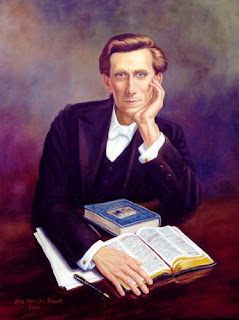
Oswald Chambers Are grace and discipleship at odds? No, though some approaches to following Jesus leave grace behind and grab for other things. Oswald Chambers addresses this problem in the July 2 reading in  My Utmost for His Highest : "If the closest relationships of life clash with the claims of Jesus Christ, He says it must be instant obedience to Himself. Discipleship means personal, passionate devotion to a Person, Our Lord Jesus Christ. There is a difference between devotion to a Person and devotion to principles or to a cause. Our Lord never proclaimed a cause; He proclaimed personal devotion to Himself. To be a disciple is to be a devoted love-slave of the Lord Jesus. Many of us who call ourselves Christians are not devoted to Jesus Christ. No man on earth has this passionate love to the Lord Jesus unless the Holy Ghost has imparted it to him. We may admire Him, we may respect Him and reverence Him, but we cannot love Him. The only Lover of the Lord Jesus...

Keeping it practical: boiling down a bazillion words

Image
This post was contributed by worship leader Mike Hale. A reader sends a great question, “What songs and hymns reflect the theology that is represented on this Trinitarian worship blog?” For the past year we’ve touched on the theology of T.F. Torrance and J.B. Torrance , and a generation of theologians they mentored, such as Andrew Purves , Chris Kettler and John McKenna , as well as an even younger generation of teachers such as Julie Canlis , Jeff McSwain and Robin Parry . What we’ve seen is that this Christ-centered, Trinitarian, incarnational theology has everything to do with worship! And how is the essence of this th eology put into songs for the people of God? We do well to revisit the wisdom of one of T.F. Torrance’s great teachers, Swiss theologian Karl Barth—arguably the most significant theologian of the 20th century, and perhaps the most important theological voice since the Reformation. Christianity Today called Barth “…one of the giants in the history of theology.” ...