Posts

The church's holiness & catholicity (Nicene Creed #10)

This post continues our look at the marks (identifying characteristics) of the Church as defined by the Nicene Creed . For other posts in this series, click a number: 1 , 2 , 3 , 4 ,  5 ,  6 , 7 , 8 , 9 , 11 , 12 ,  13 . We come now to the church's holiness and catholicity. Holiness As noted by Thomas F. Torrance in The Trinitarian Faith , though holiness is God's will for the church... ...[it] does not derive from any moral goodness or purity of its members, but from the holiness of God the Father, the Son and the Holy Spirit. The holiness of the Church is thus objectively grounded in the utterly transcendent holiness, glory and purity of God's being (pp280-281). God comes among his people, the church, and in doing so sanctifies them - or as T.F. says, "implicates them" in God's own holiness. Coming among them as a holy God would annihilate his people, except that he comes with grace and mercy, and, ultimately, he comes through the incarnation of ...

Merry Christmas!

Image
Each Christmas reminds us anew of the glorious truth concerning the birth of Jesus Christ - God in the flesh come to rescue us through his life, death, resurrection and ascension. The video embedded below presents Christmas in this whole-gospel context. May your Christmas celebrations be similarly focused, leading to an even deeper appreciation of God's love for you and all humanity.

‘Our Heavenly Father’ – Praying to the Abba of Advent

This post was contributed by worship leader Mike Hale. In The Lord and His Prayer , N.T. Wright says the word ‘Father’ in the prayer Jesus taught his followers (the Lord's Prayer) calls our attention to the revolutionary message and mission of Jesus that is the real Exodus message -- the message of the defeat of tyrants, oppressors and evil. It is the Father’s revolution that comes through the suffering and death of none other than the Messiah who is the Father’s Son.  Wright says our Lord taught us this prayer because the Advent message is that the Father’s revolution comes through the Messiah and his followers “sharing and hearing the pain of the world, that the world may be healed” (p 19). In John’s Gospel, Jesus uses the image of father and son to explain what he was himself doing. In that culture, the son is apprenticed to the father. He learns his trade by watching what the father is doing. When he runs into a problem, he checks back to see how his father tackles it. T...

When do you become a child of God?

One of the readers of this blog sent this question: Ephesians 1:13 says, “And you also were included in Christ when you heard the word of truth, the gospel of your salvation.”  How then can we say that the whole world is already included in Christ, when not everyone has yet heard the gospel? To answer, we need to note the larger passage in Ephesians chapter one (vv3-14, with v13 bold-faced): 3 Praise be to the God and Father of our Lord Jesus Christ, who has blessed us in the heavenly realms with every spiritual blessing in Christ. 4 For he chose us in him before the creation of the world to be holy and blameless in his sight. In love 5 he predestined us to be adopted as his sons through Jesus Christ, in accordance with his pleasure and will-- 6 to the praise of his glorious grace, which he has freely given us in the One he loves. 7 In him we have redemption through his blood, the forgiveness of sins, in accordance with the riches of God's grace 8 that he lavished on us wi...

Does your eschatology suffer from "ascension deficit disorder"?

Image
The Theological Turn in Youth Ministry  by Andrew Root and Kenda Creasy Dean includes a chapter from Dean titled,  Ascension Deficit Disorder (Youth Ministry as a Laboratory for Hope). She masterfully shows that the purpose for eschatology (the study of God's ultimate purposes for humankind) is not to help us predict the future, but to give us hope - a commodity often in short supply due to what Creasy calls, " ascension deficit disorder (A.D.D.)," which is the tendency: ...to act as though the future God has promised in Jesus Christ is a fairy tale, which shrivels our ability to practice hope. When we don't believe that Christ's promise to secure the future is true, we live as people fearful for our own prospects, protecting ourselves instead of allowing the Holy Spirit to use us as Christ's witnesses. A.D.D. is the reason churches get distracted so easily from the work Jesus commissioned us for: to be his witnesses throughout the earth. Instead, we are sty...

The oneness of the Church (Nicene Creed #9)

In this post we continue looking at the marks (identifying characteristics) of the Church as defined in the Nicene Creed . For other posts in the series, click a number: 1 , 2 , 3 , 4 ,  5 ,  6 , 7 , 8 , 10 , 11 ,  12 ,  13 . As with the other marks of the Church, the Creed presents its oneness as grounded in its union and communion with the Holy Trinity. As noted by Thomas F. Torrance (in his book,  The Trinitarian Faith ), the Trinity is... The regulative center to which all the worship, faith and mission of the Church take their shape: from the Father, through the Son and in the Spirit, and to the Father, through the Son and in the Spirit (p263a).  The Creed thus proclaims a Christ-centered, incarnational (participatory), Trinitarian ecclesiology (doctrine of the Church). T.F. continues: Everything we say of the Church must be consistent with the consubstantial oneness between the Son and the Father and be an expression of the union and communio...

A God of wrath or of love?

Is the God of the Old Testament a different God than the one portrayed in the New Testament? The answer is no, there is one God, who is revealed to us through Jesus as a triune communion of love: Father, Son and Holy Spirit. Certainly, the Old Testament is full of examples of God punishing various nations and people (including Israel, his own people). The following post from Surprising God reader Jerome Ellard, addresses this issue: "The Old Testament shows that God's punishments (or what he allows to beset his people) are the long, difficult road to restoration of relationship with him that he desires for them. All through the Old Testament we see the phrase "they will be my people and I will be their God." Here is a prime example, right in the middle of warnings and punishments: “Is not Israel still my son, my darling child?” says the Lord. “I often have to punish him, but I still love him. That’s why I long for him and surely will have mercy on him"...

‘Our Heavenly Father’ – praying to the Abba of Advent

This post was contributed by worship leader Mike Hale. In chapter one of The Lord and his Prayer , (Wm. B. Eerdmans Publishing Co.) N.T. Wright says that when we come to our personal place of prayer, among other things, we are coming to “lay hold of the love of God which has somehow already laid hold of us,” and that in our heart of hearts, we want to know and love him, and be able to truly call him Father. However the author also encourages us to ask what was going on in Jesus’ life when he called God Abba , Father, and taught his followers to do so too? What can we learn about who Jesus was and is, as well as about the mission of Jesus and all who Jesus taught to share in this prayer to Abba ? According to Wright, the word speaks to revolution and hope - the hope of Advent . True, the Lord’s use of the word Abba in the prayer reveals a new level of personal intimacy with God, but Wright also says the word drew into one point the vocation and salvation of Israel, noting The first o...

The Church (Nicene Creed #8)

Image
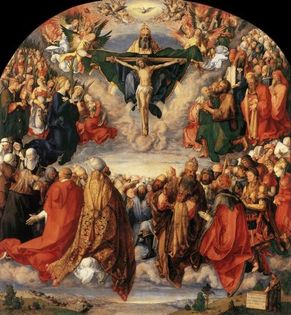
The Adoration of the Trinity by Albrecht Durer, 1511 In this post we continue exploring the Nicene Creed . For other posts in this series, click a number: 1 ,  2 ,  3 ,  4 ,  5 ,  6 , 7 ,  9 , 10 , 11 ,  12 ,  13 . We come now to the section of the Creed that addresses the Church: [We believe] in the one holy catholic and apostolic Church. We confess one baptism for the remission of sins; we look for the resurrection of the dead and the life of the world to come. Note that the Creed declares the church to be  one, holy, catholic  and apostolic . These identifying characteristics are sometimes referred to as the "marks" of the Church. It is vital to see these characteristics within the overall Trinitarian context of the Creed. One Church The Creed declares that the church to be one  in the sense that it is rooted in and thus expresses the essential oneness of the triune God. Reflecting on this, T.F. Torrance (i...

The Eternal Spirit (Nicene Creed #7)

In this post we continue exploring the Nicene Creed . For other posts in the series, click a number: 1 ,  2 ,  3 ,  4 ,  5 ,  6 , 8 , 9 ,  10 , 11 , 12 ,  13 . We come now to the section of the Creed that addresses the Holy Spirit: The Holy Spirit, the Lord, the Giver of Life, who proceeds from the Father, who with the Father and the Son together is worshipped and glorified; who spoke by the prophets. As T.F. Torrance notes (in The Trinitarian Faith ), the Creed presents the Holy Spirit as... ...God himself...immediately present in our midst, miraculously and savingly at work, and through him God reveals himself as Lord , for God himself is the content of what he does for us and communicates to us. The Spirit is not just something divine or something akin to God emanating from him, not some sort of action at a distance or some kind of gift detachable from himself, for in the Holy Spirit God acts directly upon us himself, and in giving us ...

The Incarnate Savior (Nicene Creed #6)

This post continues our series exploring the Nicene Creed (read other posts in the series by clicking a number:  1 , 2 , 3 , 4 , 5 , 7 , 8 , 9 ,  10 , 11 ,  12 ,  13 ). We come now to important words defining the Person and work of Jesus Christ: Who for us men and our salvation, came down from heaven, and was made flesh from the Holy Spirit and the Virgin Mary, and was made man and was crucified for us under Pontius Pilate. He suffered and was buried, and the third day he rose again according to the Scriptures and ascended into heaven, and sits on the right hand of God the Father. And he shall come again in glory to judge both the living and the dead; his kingdom shall have no end. A key point here is that our salvation is the act of God himself, who through the Incarnation... ...takes the concrete form of the actual historical man Jesus. As St Paul had expressed it: "God our Savior desires all men to be saved and to come to the  knowledge of the truth. Fo...

Nicene Creed video

Image
Here's a moving rendition of the Nicene Creed - a worshipful meditation with music. Enjoy! And for commentary on this important creed, click on the corresponding number of each post in a continuing series:  1 ,  2 ,  3 ,  4 , 5 .

Do we turn faith into a human work?

Image
We must avoid the tendency to see our faith as what saves us, thus turning faith into a human work. For a related discussion (with a powerful illustration), watch the excerpt below from a You're Included interview with trinitarian theologian Dr. Elmer Colyer.  Click here  for more You're Included interviews.

Jesus Christ, God's Son (Nicene Creed #5)

This post is part 5 in a series on the Nicene Creed . To read others, click on a number: 1 , 2 , 3 , 4 ,  6 ,  7 , 8 , 9 ,  10 , 11 ,  12 ,  13 . In this post, we'll examine the section in the creed concerning Jesus Christ, God's Son: [ We believe ] in one Lord Jesus Christ, the only begotten Son of God, begotten from his Father before all ages, Light from Light, true God from true God, begotten not made, of one being with the Father, through whom all things were made. Note how the creed defines Christ as  from his Father . In this eternal relationship, he is begotten   not made. The Father-Son relationship precedes any Creator-creature relationship. This, of course, was a key issue when the creed was written. All sorts of heretical ideas conceived of Jesus as some sort of creation of God rather than as true God . The creed shows such ideas to be false by asserting the biblical truth that Christ is the One through whom all things wer...

Can people get out of hell?

Image
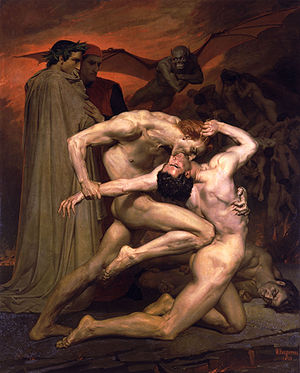
[Updated 7/25/2023] Can people get out of hell? To answer this question, we need to consider two others:  Is a person's fate determined permanently at death?  If not, on what basis might those in hell get out?  We'll address both questions in this post. "Dante and Virgil in Hell" by Bouquereau (public domain via Wikimedia Commons) Is a person's fate determined permanently at death? Many Christians answer "yes" to this question, typically citing Hebrews 9:27. In doing so, they understand this scripture to assert that upon death, a person is judged and the decision rendered at that time as to their eternal fate is then irreversible. However, in my view, using this passage in Hebrews to make that point is questionable. Note that the context of the verse is the universal scope of Jesus' substitutionary, atoning work, which he did "once for all" (Hebrews 9:26). He does not accomplish this work at some future time (such as some point p...

Father Almighty, our Creator (Nicene Creed #4)

This post is part 4 in a series that explores the Nicene Creed .  To read other parts, click on the corresponding number:  1 ,  2 ,  3 , 5 , 6 , 7 , 8 , 9 ,  10 , 11 ,  12 ,  13 . We come now to the section of the Creed that speaks of God the Father: One God the Father Almighty, Maker of heaven and earth and of all things visible and invisible. Here the Creed asserts that the one God, in the person of the Father Almighty,  is Creator ( Maker ) of all that is. As we noted in part two of this series, the Creed emphasizes that God is  one  in being (Gk= ousia ). Yet now the Creed begins to speak of the three persons of the one God, beginning with the Father, who as Almighty, is associated with his act of creating. This does not mean that the Father is Creator to the exclusion of the Son and Spirit. Rather (as noted by Tom Torrance in  The Trinitarian Faith), the Creed is granting "primacy to the concept of the Fatherhoo...

A Trinitarian, relational worldview

Image
How does one make sense of the world and God's relationship with it? These are always big questions, but of particular note as we remember 9/11. Though the video below does not address 9/11 specifically, it provides relevant insight. Jim Cantelon, a host of the Canadian program 100 Huntley Street , interviews L.T. Jeyachandran concerning how a trinitarian, relational theology informs L.T.'s understanding of the world. L.T. is an apologist and speaker who oversees the Singapore operations of Ravi Zacharias International Ministries . Food for thought (and feel free to comment)!

What can we sing at times like these?

This post was contributed by worship leader Mike Hale. Living on the West Coast of the U.S., I was up early to do business with my East Coast clients—including those in Manhattan, NY—and before leaving the house I usually checked email and national headlines. But the news that morning was anything but usual, as confusing headlines and horrifying pictures of one of the Twin Towers belching flames and black smoke sent me running to the bedrooms to wake my wife and our four grade school kids. Arriving in front of the TV, we were horrified to see the second tower explode into flames, as a jetliner hit it like a guided missile. As we stared in disbelief, the kids asked questions for which we had no answers. Actually, words were failing everyone—reporters, commentators, people on the streets—as events quickly unfolded to snuff out the lives of nearly 3000 souls from 90 countries, as suicide hijackers piloted four passenger airliners into the World Trade Center in New York City, the Pentag...

One God, the Father (Nicene Creed, #3)

This is part three of a series exploring the Nicene Creed . To read other parts, click on the corresponding number:  1 ,  2 ,  4 , 5 ,  6 , 7 , 8 , 9 ,  10 , 11 ,  12 ,  13 . Part 1 looked at the Creed's history, and part 2 looked at its opening phrase,  We believe.  Now we'll expand on that, looking at the longer phrase... We believe in one God, the Father...  The Creed was written to combat heresies infecting the fourth century church. Of particular concern was the dualistic idea that God (being spirit and thus transcendent), is necessarily separate from the material world, including humanity. This non-biblical worldview, which emerged out of pagan Greek philosophy, was embraced by some influential church leaders. As a result, some denied Jesus' humanity, while others (notably Arius of Alexandria) denied Jesus' divinity. Arius and others also denied that the Holy Spirit was a divine person. The Council ...

Will all be saved?

Image
[Updated 8/27/2019] Do Grace Communion Seminary and Grace Communion International (sponsors of this blog) teach a doctrine of universalism? The answer is no---both are in agreement with the teaching on this topic from Trinitarian theologian Thomas F. (TF) Torrance who notes that, "Whether all men will as a matter of fact  be saved or not, in the nature of the case, cannot be known" ( Scottish Journal of Theology 2 [1949] 310-18, quoted in In the End, God,  by John A.T. Robinson, Wipf and Stock: 2011, p. 148). Torrance offers two reasons for this assertion: 1) The irrational mystery of evil. 2) The truth that God gives each person the freedom to say "no" to him---potentially forever. Both reasons must be seen in the light of the deeper truth of God's election , which, in Torrance's view  TF Torrance expresses the universal action of God's grace in such a way that, far from dissolving the personal elements of choice and decision, it establishes ...