Posts

Thoughts about The Shack

Image
[Updated 2/28/17] We've been hearing a lot of "buzz," both positive and negative, about the movie, The Shack . As you probably know, it's being released in U.S. theaters on March 3. I find that many of the objections to the movie are based on misunderstanding concerning the nature and content of the book The Shack  by Paul Young (the movie closely follows the book). These misunderstandings, I think, have largely to do with a failure to recognize that the book is a work of fiction. I hasten to add, however, that fiction is able to convey powerful truth---that is certainly the case with The Shack,  which, I believe, upholds the truths codified for the church in the ancient creeds, including the Nicene Creed. If you're unfamiliar with the movie, here is one of its trailers: People who are critical of the book The Shack (and thus the movie) also often fail to account for the fact that The Shack  is not only fiction, but is written in the form of an alleg...

Music and Trinitarian Theology

Image
I think you'll enjoy this GCI You're Included interview in which Dr. Jeremy Begbie shares his thoughts on the unique powers of music and how they enrich our understanding of theology.

The nature of our union with Christ

Image
This post excerpts Gary Deddo's essay, " The Christian Life and Our Participation in Christ’s Continuing Ministry" (to read the full essay, click here ). The portion excerpted here relates to clarifying the meaning of the important New Testament concept of "union with Christ." The New Testament message is that we are so united to Christ that the core of our very being is changed because it has become spiritually joined to the perfected humanity of Jesus. The apostle Paul writes that we are one in Spirit with Christ (1 Corinthians 6:17). In his letter to the Ephesians he writes that we are presently—right now—seated with Christ in the heavenlies (Ephesians 2:6). We are so joined that what happened to Christ 2,000 years ago has actually included us. So in Paul’s letter to the Colossians we read that we have co-died with Christ and have been co-raised with Christ (Colossians 2:12-3; 3:1). Paul announces this fact as a completed action that is true of all the me...

Barth's Theology of Relations, part 2

Image
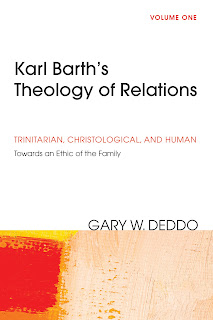
This post continues a series looking at Gary Deddo's two-volume book, " Karl Barth's Theology of Relations (Trinitarian, Christological, and Human: Towards an Ethic of the Family) ." For other posts in the series, click a number: 1 , 3 , 4 ,  5 . [Revised 1/28/17] Karl Barth Last time we noted that Gary's goal in writing is to explore Barth's theological ethic, which begins with who God is (Trinity), then proceeds to how God acts in relation to humanity (Christology), leading to an understanding of how we humans act in correspondence with who God created us to be as bearers of his image (anthropology). Gary then explores the application of this ethic to the family, including parent-child relationships, which, according to Barth, are a human counterpart of the divine Father-Son relationship. Gary elaborates: The divine being in act of God revealed in Jesus Christ is inherently relational, that is, is loving in freedom . In a corresponding creaturely...

Barth's Theology of Relations, part 1

Image
This post begins a series looking at Gary Deddo's two-volume book, " Karl Barth's Theology of Relations (Trinitarian, Christological, and Human: Towards an Ethic of the Family) ." For other posts in this series, click on a number: 2 ,  3 , 4 ,  5 . [Revised 1/13/17] Dr. Deddo's book offers a detailed analysis of what Karl Barth (in his massive work,  Church Dogmatics ) says concerning the intrinsic relationality of God as Father, Son, and Holy Spirit ( Trinitarian theology ), God's relationship to us in and through Christ ( Christology ), and how God's triune relationality is shared by humanity ( Trinitarian, Christ-centered anthropology ). Gary then shows how Barth applies these theological truths in the arena of ethics (particularly in the context of family) .  In this way, Gary defines and explores Barth's Trinitarian, Christological and anthropological perspective on human ethics. To me, having this theologically-grounded, holistic un...

Stay focused on Jesus

Image
The post below is adapted from an article by Joseph Tkach. It provides food for thought as we enter the season of Epiphany , which celebrates the revealing of Jesus Christ to the world. [Revised 1/9/17] Given that he is the final and ultimate revelation of who God is (Hebrews 1:3), Jesus must remain our focus throughout the year. Knowing who Jesus is and what he has done for us helps us grow in understanding the reconciliation we have with God and each other. In Christ, through the Holy Spirit, we are set free to love. Let's look at some related concepts. Come Follow Me by Liz Lemon Swindle (used with artist's permission) Jesus' two natures and his vicarious humanity Jesus is both divine and human--- two natures united permanently in one person,  through what theologians refer to as the hypostatic union ,  a term utilized in the early church to apprehend the truth revealed in Scripture that Jesus is the  complete, personal sharing of God in humani...

Theology matters (the Nicene faith)

Image
This post concludes a seven-part review of James B. (JB) Torrance's book, Worship, Community and the Triune God of Grace . For the other posts in the series, click a number:  1 ,  2 ,  3 ,  4 ,  5 , 6 . [Updated 12/28/2016] JB (pictured at right) sums up his purposes for writing with this important statement: I have been concerned to stress the need to recover the centrality of the doctrine of the Trinity in the life of our churches today for a number of reasons---for a better doctrine of God as a covenant God, not a contract-God; for a more biblical understanding of worship; and for a less individualist anthropology---an understanding of our humanity and our destiny in the purposes of the God of grace, to be a community of persons enjoying communion with God and with one another. (p. 95) In his final chapter, which I'll touch on only briefly here, JB confronts objections to his incarnational, Trinitarian vision. I've personally encountered some...

Christ and the wonderful exchange

Image
This post continues a review of James B. (JB) Torrance's book, "Worship, Community and the Triune God of Grace." For additional posts in the series, click a number:  1 , 2 , 3 , 4 , 5 , 7 . [Updated 12/19/2016] As noted in our last post , JB is adamant in his assertion that in approaching worship (and all aspects of theology), before we ask any  how  or why  questions, we must first ask the essential Who question: " Who is God? Who is Jesus Christ? " JB illustrates this principle by discussing the two sacraments of the church. Last time we noted what he says about baptism; now we'll look at his comments about the Lord's Supper. At the Lord's Table we encounter Jesus Christ, who through his life of communion with the Father, in the Spirit, gives himself to the Father on behalf of all people in all times (Hebrews 10:4). This self-giving, which culminated at the Cross, continues with Jesus' ministry as High Priest (Hebrews 4:14), making cont...

The key question: Who is Jesus?

Image
This post continues a review of James B. (JB) Torrance's book, "Worship, Community and the Triune God of Grace." For additional posts in the series, click a number:  1 , 2 , 3 , 4 ,  6 ,   7 . [Updated 12/11/2016] Last time we looked at the wonder of God's grace  seen in the dual mediatorial role of Jesus. JB continues this discussion in chapter three with the vital observation that in theology, our "dogmatic starting point" must be the question, "Who is God? Who is Jesus Christ?" Unfortunately, that often is not where we begin, focusing instead on the "utilitarian questions of 'how.'" JB elaborates: In our pragmatic Western society in this technological age, our starting point so often is the problems of the world, of church and society---problems of race, the inner city, unemployment, poverty, violence, injustice. These are issues of such urgent importance that we give primacy to the question of how to solve them. We ca...

The Christmas story

Image
During the Advent-Christmas season, we look forward to Jesus' second advent (coming), then back to his first (his incarnation and birth). Concerning his birth, I've reproduced below a sermon recently published on GCI's  Trinitarian Preaching  page on Facebook. Enjoy! Jesus Shares our Humanity by Ted Johnston Introduction In Luke chapter two, the beloved physician gives us a glimpse of Jesus’ early life as newborn baby, infant, and youth. Luke shows how Jesus, sharing our humanity at each stage of human development, beat back our fallen nature with the temptations it brings. At every point on this journey, Jesus (in his vicarious humanity and by the power of the Spirit) was at work re-creating our humanity. As God incarnate (sharing our flesh), Jesus not only is  with us , but as one of us, he is radically for us .  Joy to the world---the Lord is come! 1. Jesus, the newborn baby (Luke 2:1–20) Luke shows how the eternal Son of God came into the world of...