Posts

The Christian Doctrine of God (part 5)

Image
This is part 5 in a series by Torrance scholar Thomas Noble ,  summarizing Thomas F. Torrance's book  The Christian Doctrine of God: One Being Three Persons .   For other posts in this series, click a number:  1 ,  2 ,  3 , 4 , 6 . Chapter 8: THE SOVEREIGN CREATOR It is very easy when using technical terms like perichōrēsis to think concepts rather than the realities denoted by them. In the last resort they are no more than empty abstract propositions apart from their real content. In this chapter we shall be concerned to pursue an essentially dynamic approach to the coactivity of the three divine Persons denoted in the theological shorthand.  In the Nicene-Constantinopolitan Creed, belief in God as the Sovereign Creator is presented within a trinitarian structure: one God the Father Almighty, Maker of heaven and earth and all things visible and invisible; one Lord Jesus Christ through whom all things are made, and the Holy Spirit, the Lord and Giver ...
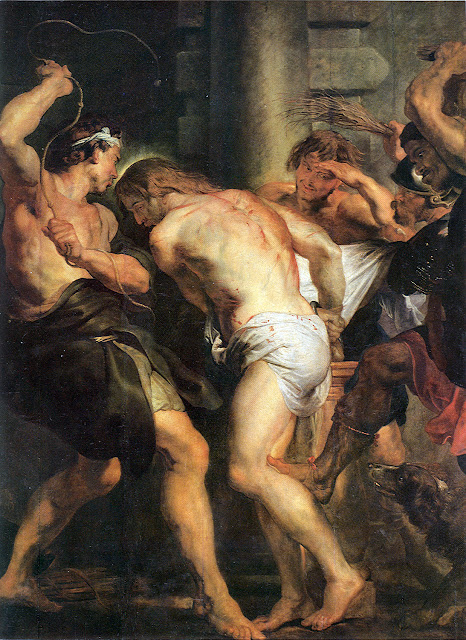
Sharing Jesus' Selflessness (preaching resource for 4/2/23, Palm/Passion Sunday)

Image
This post exegetes Philippians 2:1-11, providing context for the RCL Epistle reading for 4/2/23 (Palm/Passion Sunday). This exegesis draws on commentary from Warren Wiersbe ("Bible Expository Commentary") and Francis Foulkes ("New Bible Commentary").  "Flagellation of Christ" by Rubens (public domain via Wikimedia Commons) Introduction  When Epaphroditus brought to Paul a generous gift from the church at Philippi, he also brought disturbing news of a double threat to that congregation’s unity: false teachers from without (Phil 3:1–3) and disagreeing members from within (Phil 4:1–3). Paul is greatly concerned, and so in his epistle sent to the Philippians he pleads with them to recover a true and lasting unity.  They will do so as they, through the Holy Spirit, actively share in the self-sacrificing, compassionate mind and heart of Jesus. Note Philippians 2:1-2: 1 If you have any encouragement from being united with Christ, if any comfort from his love, if ...

Jesus is God! (preaching resource for 3/26/23, Lent 5)

Image
This post exegetes John chapter 11, providing context for the  RCL's Gospel reading for 3/26/23 (Lent 5). It draws on various sources including The Bible Expository Commentary (Warren Wiersbe), The New Bible Commentary, The Parable of Joy (Michael Card) and The Gospel of John (F.F. Bruce). "Resurrection of Lazarus" by Tanner (public domain via Wikimedia Commons) Introduction  John chapter 11 presents what John considers to be conclusive evidence that Jesus is the divine Son of God. The evidence is Jesus’ raising of Lazarus from the dead. Though not Jesus’ last miracle before the cross, it is certainly the most dramatic—one that aroused the most response from friend and foe alike.  In presenting this astounding miracle, John’s main emphasis is not on the miracle itself but on the response of faith. Indeed, John uses some form of the word believe at least eight times in the chapter.  Jesus’ intent in performing this miracle was to strengthen the faith of...

The Christian Perspective (by T.F. Torrance)

Image
This post explores "The Christian Perspective," -- chapter 2 of T.F. Torrance's book " The Christian Doctrine of God. One Being Three Persons ." This post was written by Torrance scholar Travis M. Stevick  for a session of the T.F. Torrance Reading Group . In chapter 1 ("Introduction") of  The Christian Doctrine of God ,  Torrance makes several epistemological observations that will be important as we look at chapter 2, which begins with the key perspective that authentic knowledge of God must always be, at bottom, the result of revelation , rather than logic or mere empirical observation within our creaturely world. Torrance explains that this revelation comes primarily through Jesus, understood within the context of ancient Israel (a key point that he unpacks in  The Mediation of Christ ).  While this insight has distinctly theological and distinctly Christian roots, once grasped it can be applied outside that field into other areas of study. This i...

The Miracle of Seeing Jesus (preaching resource for 3/19/23, Lent 4)

Image
This post exegetes John 9:1-41, providing context for the  RCL's Gospel reading for 3/19/23 (Lent 4). It draws on various sources including "The Bible Expository Commentary" by Warren Wiersbe. "Christ Healing the Blind Man" by Murphy (public domain via Wikimedia Commons) Introduction Jesus frequently performed miracles to meet human needs. But through those miracles he also conveyed truth concerning his identity as the Son of God and Messiah. One of the biblical signs of the Messiah was healing the blind (Matt. 11:5), and here in John chapter 9 Jesus fulfills this sign.  But he also used the miracle to say something about the human condition, for in John ‘to see’ physically is a metaphor for understanding spiritually. And so John 9 is about spiritual blindness as well as physical blindness and about how Jesus, the Messiah heals both. The man we meet in John 9 was both physically and spiritually blind from birth.  But Jesus changed both conditions: The healing of...