Posts

The Trinity and Mission (preaching resource for 6/4/23, first Sunday after Pentecost, Trinity Sunday)

Image
This post is adapted from a Surprising God post by Randy Bloom, Chairman of the Board of Directors for both Grace Communion International and Grace Communion Seminary. "Come and See" by Liz Lemon Swindle (used with artist's permission) Introduction At the end of the 28th chapter of the Gospel of Matthew, we are given an important statement from Jesus to his disciples often referred to as The   Great Commission : 16 Now the eleven disciples went to Galilee, to the mountain to which Jesus had directed them. 17 And when they saw him they gworshiped him, but some doubted. 18 And Jesus came and said to them, h“All authority in heaven and on earth has been given to me. 19 Go therefore and make disciples of all nations, baptizing them in the name of the Father and of the Son and of the Holy Spirit, 20 teaching them to observe all that I have commanded you. And behold, I am with you always, to the end of the age.” (ESV) Notice here how Jesus connects the mission of the church to ...

One Spirit, One People, One Calling (preaching resource for 5/28/23, Pentecost)

Image
This sermon addresses 1 Cor. 12:3b-13, drawing on commentary from various sources including "The Bible Expository Commentary" (Warren Wiersbe) and "The New Bible Commentary" (Bruce Winter).  "The Coming of the Holy Spirit at Pentecost" by Cochin (public domain via Wikimedia Commons) Introduction On Pentecost Sunday, 50 days after Jesus’ resurrection, Peter addressed a crowd of Jews gathered as the result of the powerful signs that accompanied the outpouring of the Holy Spirit on Jesus' disciples. Acts 2 records part of what Peter preached to that crowd, including this from the prophet Joel: In the last days, God says, I will pour out my Spirit on all people.  Though some call this particular day of Pentecost the "birth of the Church," it is perhaps more accurate to call it the church's "re-birth." Understood as the people of God , the church actually began with Abraham, leading to Israel, the church formed and commissioned under...

The Prayer of the Overcomer (preaching resource for 5/21/23, Easter 7)

Image
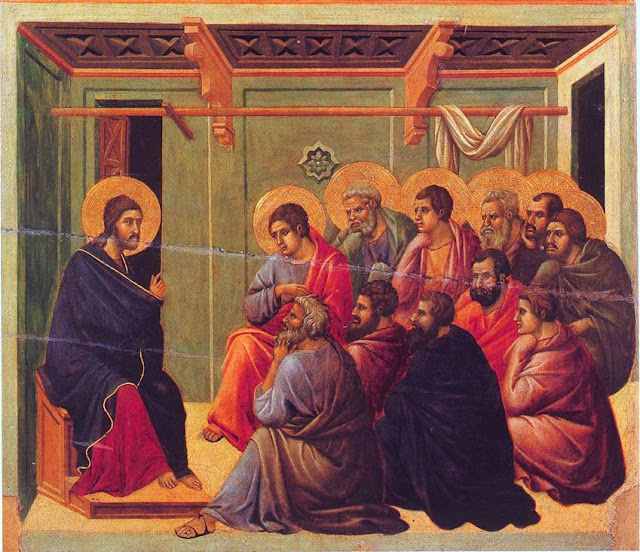
This exegesis of John 17 provides context for the RCL reading in John for 5/21/23. It draws on multiple sources including "The Bible Expository Commentary" (Warren Wiersbe), "The New Bible Commentary," "The Parable of Joy" (Michael Card), and "The Gospel of John" (F.F. Bruce).  "Christ Taking Leave of the Apostles" by Duccio (public domain via Wikimedia Commons) Introduction The setting of John 17 is late on Maundy Thursday evening during Holy Week, perhaps still in the Upper Room at the Last Supper, or perhaps in or near the Garden of Gethsemane where Jesus met often with his disciples to pray.  In any case, this chapter presents what Warren Wiersbe refers to as the “holy of holies” of the Gospels—an account of the prayer of God the Son conversing with God his Father just as Jesus is about to give his life as a ransom for us all.   This prayer makes it clear to us that Jesus truly is the Overcomer .  From a human perspective his arrest...

Reassurance for Troubled Hearts, part 2 (preaching resource for 5/14/23, Easter 6)

Image
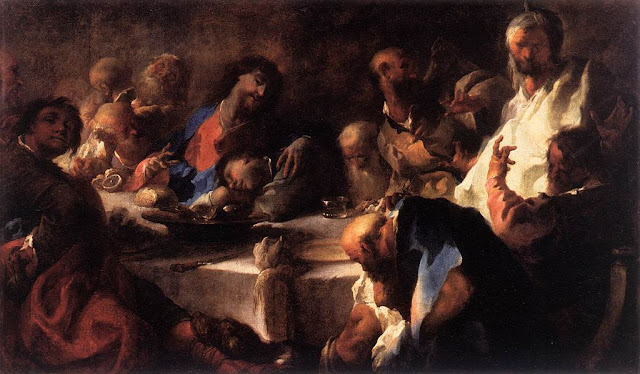
This post exegetes John 14:16-31 to provide context for the RCL Gospel reading for 5/14/23. It draws on multiple sources including "The Bible Expository Commentary" (Warren Wiersbe), "The New Bible Commentary," "The Parable of Joy" (Michael Card), and "The Gospel of John" (F.F. Bruce).  "The Last Supper" by Maulbertsch (public domain via Wikimedia Commons) Introduction This post concludes a two-part exploration of  John 14, which records part of  Jesus’ Upper Room discourse on the night before his crucifixion. The chapter opens and closes with our Lord’s loving admonition to his disciples: “Do not let your hearts be troubled” ( John 14:1 ,   27 ). Between these ‘bookends’ are six  wonderful assurances designed to calm those troubled hearts. Part 1  covered the first three assurances: 1) We will be with God forever, 2) We know the Father right now, and 3) We have access to God in prayer. We'll now look at the last three: 4) We have t...

Reassurance for Troubled Hearts, part 1 (preaching resource for 5/7/23, Easter 5)

Image
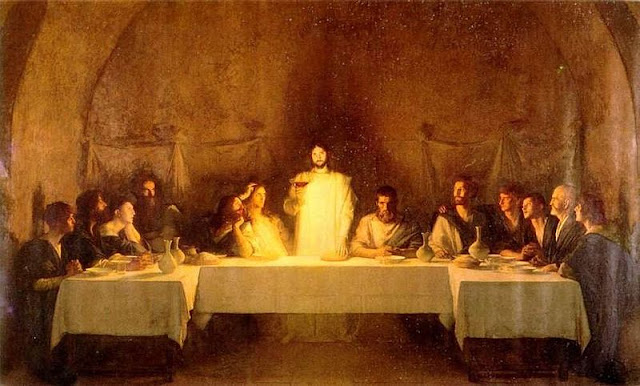
This post exegetes John 14:1-15, the RCL Gospel reading for 5/7/23. This exegesis draws on various sources, including "The Bible Expository Commentary" (Warren Wiersbe), "The New Bible Commentary," "The Parable of Joy" (Michael Card), and "The Gospel of John" (F.F. Bruce).  "Last Supper" by Bouveret (public domain via Wikimedia Commons) Introduction We begin with the last verse of John chapter 13: 13:36 Simon Peter asked him, "Lord, where are you going?" Jesus replied, "Where I am going, you cannot follow now, but you will follow later." 37 Peter asked, "Lord, why can't I follow you now? I will lay down my life for you."   38 Then Jesus answered, "Will you really lay down your life for me? I tell you the truth, before the rooster crows, you will disown me three times! 14:1 "Do not let your hearts be troubled. Trust in God; trust also in me. John chapter 14 continues Jesus’ Maundy Thursday even...

The Church's Life (preaching resource for 4/30/23, Easter 4)

Image
This post exegetes Acts 2:42-47, one of the RCL readings for 4/30/23. This exegesis draws on various sources, including commentary on this passage from John Stott.  "Pentecost" (public domain via Wikimedia Commons) Introduction The second chapter of the book of Acts focuses on the Holy Spirit's work in forming the church both on and immediately following the day of Pentecost. The chapter has three sections, each one addressing the activity of the Holy Spirit in the life of the early church.  Chapter 2 begins with Luke's description of Pentecost (1-13), continues with the explanation of the events of that day which Peter gives in his sermon (14-41), and ends with the effects of Pentecost in the life of the Jerusalem church (42-47). This sermon addresses the third section, wherein Luke describes the effects of the outpouring of the Holy Spirit at Pentecost by giving us a beautiful synopsis of the Spirit-filled church. What evidence did the church give of the presence an...

The Christian Doctrine of God (part 6)

Image
This post is the sixth in a series written by Torrance scholar Thomas Noble  summarizing Thomas F. Torrance's book  The Christian Doctrine of God: One Being Three Persons .   For other posts in this series, click a number: 1 ,  2 ,  3 ,  4 , 5 . Chapter 9: THE UNCHANGEABLENESS OF GOD The unchangeableness of God is one of the major themes of the Old Testament. ‘I am who I am: I shall be who I shall be’: the self-existing, self-living, self-affirming God. This incomparable God  is not to be understood on the analogy of our finite creaturely human being with whom word, act and person are different from one another. He meets us, speaks to us, acts towards us as One whose Word and Act and Person are inseparable from one another. He is in Person identical with his Word, and his Word is itself his Act. Hence, God’s Being is neither mute nor inactive, bur inherently eloquent and active. His being is his Being in his Act and his Act is his Act in his being: hi...