Posts

Male and female as the image of God

God created man in his own image, in the image of God he created him; male and female he created them  (Genesis 1:27). According to Frances and Paul Hiebert, the humanity that images God is a  co-humanity  constituted by men and women in relationship. Stated negatively, men alone and women alone do not express fully the image of God   (see the Hiebert's essay,  The Whole Image of God: A Theological and Anthropological Understanding of Male-Female Relationship,  in Incarnational Ministry ,  edited by Kettler and Speidell). This makes sense in light of the biblical revelation that our triune God is a relational communion of three persons (Father, Son and Holy Spirit), in which there is unity, diversity (distinction of persons) and equality . God's communitarian nature is imaged in humanity when a similar unity, diversity and equality are found in us - particularly in our male-female relationships. According to the Hieberts, differing male and ...

Utilizing Worship Fusion – Amazing Grace (My Chains Are Gone)

Image
This post was contributed by worship leader Mike Hale. A “blended” worship service commonly means a service designed to use both traditional hymns as well as contemporary songs or choruses—whether the mix leans more heavily to one side or the other, or is right down the middle. (Of course you can also use other styles of music as well, but for this discussion let’s stick with hymns and choruses.) However, creative writers and musicians sometimes go beyond just sprinkling hymns and choruses throughout the worship list for the day and take the extra step of creating one piece of music that is more a “fusion” of something old and familiar with something fresh and new. Using symbols to describe th e process—just placing two different worship styles one after another (for example, a contemporary chorus after a traditional hymn) can be represented as A + B = AB. Whereas creatively fusing these elements together in such a way that both are mutually transformed into a new third thing can be se...

A Trinitarian Theology of Family Ministry

Image
How may the church join with Jesus in what he is doing through the Holy Spirit to minister God's love and life to and through families? Dennis Guernsey answers in  Family Ministry and a Theology of Family: A Personal Journey, an essay in Incarnational Ministry   (eds: Kettler and Speidell). Guernsey, now deceased, teamed with Ray Anderson at Fuller Theological Seminary to develop an approach to family ministry informed by Trinitarian theology and family systems psychology ( click here  for details). In Guernsey's view, "family" is best understood as a verb, rather than a noun. Family is about being "familied." Unfortunately, some family ministries are more about programs and structures than about loving, family-like relationships . As guidance to churches wishing to join with Jesus in relational ministry to and through families, Guernsey offers five theological principles: 1.  "Human persons are created in the image of God and are of infinite valu...

Is the Holy Spirit God?

This was posted on Pentecost Sunday--a good day to address a question sent in by one of our readers, a church pastor: "Within the past year, two long-time members have relocated from other parts of the country to one of my congregations. Neither of these individuals believes in the deity of the Holy Spirit, believing instead our old teaching that the Holy Spirit is some kind of energy or power of God.  Why is it necessary to believe in the deity of the Holy Spirit? Why isn't faith in Jesus Christ enough?" To believe in the deity of the Holy Spirit is to understand that he, like God the Father and God the Son, is fully God. This contrasts with the mistaken idea that the Holy Spirit is merely the "power" or the "wisdom" of God, in an impersonal sense. There are many reasons why it is vital to uphold the deity of the Holy Spirit. I'll comment on two here. I invite our readers to add others (use the comments feature below). 1. The Bible ...

Leadership of the Jesus kind

In The Ministry of Leadership: Empowering People (an essay in the book Incarnational Ministry ), Walter C. Wright, Jr. defines Christian leadership as a relationship by which the leader works to empower, nurture and increase the maturity of the follower as a person loved by God (p207). This leadership of 'the Jesus kind,' is servant-leadership that transforms.  Whereas current literature tends to define leadership as a process by which individuals or groups are influenced toward a particular outcome or goal (p207), Jesus' way of leadership is principally about relationship . Of course, relationships involve influence, but the principal focus of Jesus is not to influence his followers toward an external objective (no matter how lofty), but to love and serve them with an eye toward their empowerment, leading to the positive transformation of their lives. Jesus demonstrated this radical approach to leadership at the Last Supper, where he washed his dis...

What about mission?

Image
Given the biblical revelation that God has reconciled all humanity to himself in and through Jesus Christ (2 Cor, 5:17-19), why should the church be concerned about reaching out to the world in mission? And if it is to be concerned, what does that mission look like? In order to answer these questions, we first must answer this one:  Who is God?  The Bible;s answer is that the one God exists eternally as a tri-personal communion of love. In his being (nature), God is love (1John 4:8), and God does what God is. The triune God of love is a God who, in love, reaches out to others. Missional God In love, God created the cosmos as a time/place in which to share his triune love and life with his creation. And because his love never ceases or diminishes, he became Redeemer to rescue his creation from its inability, due to the fall, to live in communion with him. As Creator and Redeemer, God has, from before time, been on mission. The mission of God ( missio Dei) in cre...

Generous God: generous people

Trinitarian, incarnational theology shapes our understanding of Christian stewardship . It points us to the life and love of Jesus, who represents and substitutes for us as the perfect human steward of God's grace in all its forms ( 1Pet 4:10 KJV). From this perspective, Christian stewardship is a believer's active participation in Jesus' lavish generosity (his own love, which "compels us," see 2Cor 5:14 ), as he lives in union with the Father and the Holy Spirit (in the Trinity), and with all humanity (through his continuing incarnation). I'm reminded here of a phrase coined by Mark Vincent in A Christian View of Money : Generous God, generous people .    In the above cited passage from Peter's first epistle, the Apostle is addressing the stewardship of spiritual gifts (one aspect of God's amazing and bountiful grace to us). These gifts are the very ones that Jesus possesses in himself. Through the indwelling Spirit, he shares these gifts (ab...

Lighten up already! Karl Barth’s remedy for thinking too highly of ourselves

Image
Sure, ministry involves the important stuff of life, but have you ever attached so much importance to the ministry in which you serve that you begin losing your sense of playfulness, humor or joy? Or in taking your role as a servant seriously, have you also begun taking yourself a bit too seriously? It’s an easy trap to fall into. (Confession time here. In leading worship through the years, I’ve seen more than a few photos of myself looking more serious than a solemn judge, and not so much like a joyful worshiper. Though none of us will do it perfectly, those who serve in visible roles should be aware of the impressions given.) And if we take ourselves too seriously, we might also think too highly of ourselves and our work—especially if folks regularly offer thanks and appreciation for our work. Remedy arrives in the wisdom a nd humor of Swiss theologian Karl Barth . Barth was perhaps the most highly acclaimed theologian of the 20th century, and no one had written more about the s...

Gospel-centered baptism

Image
This post was contributed by worship leader Mike Hale. "Baptism of Christ" by Zelenka (public domain via Wikimedia Commons) In an essay in Incarnational Ministry: The Presence of Christ in Church, Society, and Family: Essays in Honor of Ray S. Anderson , Colin Gunton writes against an individualistic approach to baptism and for a gospel-centered approach. In doing so, he addresses various pastoral concerns, including the practice of infant baptism. Against an individualistic approach Gunton decries an approach to baptism that emphasizes the individual person, thus separating baptism from the shared life of the church: While baptism is in part the concern of the particular person, it is not primarily a matter for the person as individual but for the person in relation to other people in the community of salvation, the covenant people of God. Baptism cannot, and should not be treated in isolation form the life of the community of faith (p100). Historically, individualisti...

Keeping it practical: understanding how to lead in a worship setting

Our recent posts have discussed the relationship of the Church’s worship in the earthly realm and the ongoing intercession of Christ at the right hand of God where saints and angels give praise and thanks. We were reminded that through the power and working of the Holy Spirit we participate in that heavenly worship and are included in our Mediator Christ’s ongoing intercession and prayers—as well as in the Son’s ongoing praise and thanks to the Father. Scrolling down the right hand of this page in the quote section you will find this quote: "Christ receives all that we offer God, in thanksgiving, in worship, and in service, converts it in himself, and presents it as something prefect and wholly acceptable to his Father, who is our Father...The theology of incarnation reminds us that all humanity has been caught up in Christ's ascended and glorified humanity, so making it possible for us to participate by the Spirit in the Son's perfect communion with his Father" (Gra...

A three-fold ministry of the Word

This post was contributed by worship leader Mike Hale. The book  Incarnational Ministry, the presence of Christ in Church, Society and Family contains an essay by Geoffrey Bromiley, The Ministry of the Word of God. Bromiley notes that some (including many of the Reformers) define the Word of God as the Bible. However, Bromiley (following Karl Barth and others), views that definition as incomplete. For him, the Word of God is three-fold: a "triune perichoresis" of the written Word of God (Holy Scripture), the proclaimed Word of God  (the church's proclamation of the apostolic gospel), and first and foremost  the incarnate Word of God , Jesus Christ. For Bromiley, this three-fold Word informs and shapes a three-fold ministry of the Word . Following is a summary of his thoughts concerning each part: 1. Ministry of the incarnate Word Ministry is not our own - it is our participation (as the body of Christ) in the ministry of, by and through t...

Our part in God's ministry of atonement

Image
The book  Incarnational Ministry, the presence of Christ in Church, Society and Family  contains an essay by Christian Kettler,  The Atonement as the Life of God in the Ministry of the Church. Kettler notes that God's ministry ( his doing ) expresses his being as the God of love and grace. As we (the church) participate with God in his ministry, we learn more about his being. In this way,  ministry precedes theology. However, the reverse is also true - our participation with God in his ministry grows as our understanding of his being (our theology) deepens. This dynamic interaction of ministry and theology is liberating, setting the church free to "determine its ministry based on  who  God is and what he has  actually  done, rather than what would sell in the marketplace of ideas and religions and in 'self-help' books" (p60). This being true, we ask,  what is God's ministry ? The answer has many facets, but a primary one is that ...

An incarnational view of holiness

Image
The book  Incarnational Ministry, the presence of Christ in Church, Society and Family  contains an essay titled,  Holy God, Holy Church ,  in which Donald McCullough examines from a Trinitarian, incarnational perspective what the Bible says about holiness. Holiness in the Old Testament McCullough begins where the OT starts, with holiness as a religious concept, having to do with that which is separate: As applied to the cult [OT religious system], the holy things of God are perceived as set apart for his service; and second, as applied to the name and person of God, God himself is understood as set apart. Thus [in the OT] holiness is first a religious,  not an ethical, term (p17). Then the OT develops an  ethical conception of holiness: "Because God has set apart not only objects for his use but a people as well, there emerges the idea of a holy people who live according to a unique standard of conduct" (p17). This comes to the...

Have a joy-filled Holy Week

In the midst of Holy Week - the very heart of the Christian calendar - we pause to consider what is laid out for us to understand, and in understanding to experience: Jesus' entering Jerusalem as the servant-King come to suffer and die for his subjects (Palm Sunday). Jesus' gathering his followers for the Last Supper; sharing the glorious truths about who he is and what he is about to do for them and all humanity (Maundy Thursday). Jesus' dying on Calvary's cross - the great and complete sin offering that secures forgiveness for all (Good Friday). Jesus' going to the grave where in death he experiences the depth of our corruption - the consequence of sin (Holy Saturday). Jesus' rising from death; born again to new, glorified human life; securing in himself this new birth for all (Easter Sunday). Happy Holy Week!

Incarnational Ministry

Image
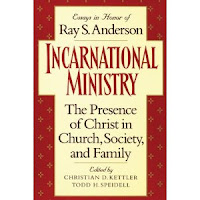
The book,  Incarnational Ministry, the presence of Christ in Church, Society and Family (1990, edited by Christian Kettler & Todd Speidell), features essays in honor of Ray Anderson. Ray (now deceased), is widely regarded for advocating an incarnational approach to ministry grounded in a Trinitarian, Christ-centered theology. According to the editors, this approach emphasizes... ...the critical significance of Christ's continued ministry through his church... [a ministry which] cannot be conducted as a mere matter of technique, as if the social and behavioral sciences contributed more to the practice of ministry than theology itself. Theology that is true to the incarnate Savior will inform and enable ministers of Christ's church to understand better, and participate in more effectively, the ministry of Christ through his church. (pxiv) Referencing Thomas F. Torrance, the editors define incarnational ministry as, "the ministry of God in becoming a per...

Resurrection, Revelation, and the ‘Trajectory of Worship’

This post was contributed by worship leader Mike Hale. Easter is a time for the really big celebration songs—time to joyously proclaim with expectancy and with all our might, the grace, the living hope, and new life of the risen and ascended Lord Jesus—our bodily risen Savior who lives to minister and share this life with us by the Spirit and to the glory of the Father. It’s time to sing Christ the Lord Is Risen Today , and big hymns such as Crown Him With Many Crowns and Holy, Holy, Holy, Lord God Almighty . At Easter time when I was a kid, the church pipe organ thundered and testified till we could feel the vibrations in our chest and through the floor and the soles of our shoes! Presently, folks in our small congregation say one of their favorite big songs is the Revelation Song , written by Jennie Lee Riddle and made popular by Kari Jobe, pictured left. [Click here to see Kari sing the song.] In the March 26 post we highlighted and commented on portions of an excellent ar...

Are all forgiven?

Image
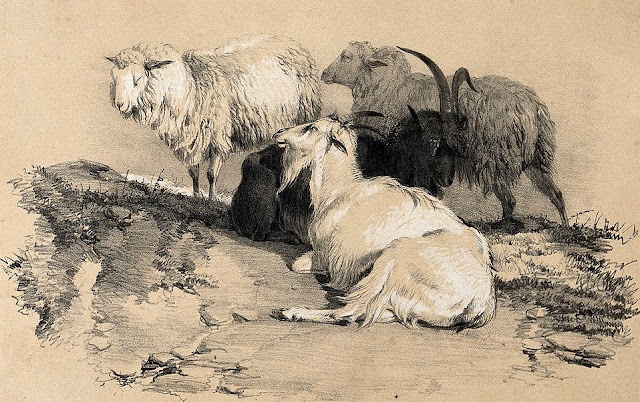
A Trinitarian-incarnational view of the gospel proclaims that God has reconciled all humanity to himself through the vicarious humanity of Jesus. In Jesus, all are forgiven, accepted and included in God's love and life (see 2Cor 5:14-21 ). But how can it be said that God has forgiven those who have not repented - not turned to him in faith? Doesn't the idea of universal reconciliation conflict with Jesus' words in Matthew 25? 31 "When the Son of Man comes in his glory, and all the angels with him, he will sit on his throne in heavenly glory. 32 All the nations will be gathered before him, and he will separate the people one from another as a shepherd separates the sheep from the goats. 33 He will put the sheep on his right and the goats on his left. 34 Then the King will say to those on his right, 'Come, you who are blessed by my Father; take your inheritance, the kingdom prepared for you since the creation of the world.'  ...41 Then he will say to t...