Posts

Music and Theology

Image
Click here  to watch a YouTube video on the relationship between music and theology from Jeremy Begbie, professor at Duke and Cambridge Universities. Begbie asserts that time is one component of the Gospel that is better understood through the arts in general and music specifically. Because music unfolds in time, it implicitly affirms the biblical understanding of time as good, which is contrary to philosophies that scorn time and activities that take time.


The Renewal of Trinitarian Theology

Image
Gary Deddo put me on to the book The Renewal of Trinitarian Theology: Themes, Patterns & Explorations  by Roderick T. Leupp (IVP 2008).  It's a helpful compendium of ideas from various sources concerning trinitarian theology. Following are representative quotes (see the book for sources). Trinitarian theology "The Christian calling is not to ingenious speculation about how God can be three and yet one, one and yet three, but is rather a firm adherence to the truth of the incarnation, and a glad acceptance of the benefits of the Father's eternal Word appearing in flesh in Jesus Christ, and a sturdy resolve to transform the world in the power of the Holy Spirit" (p. 10). "The doctrine of the Trinity is that wherein all Christian teaching finds its reason to be" (p. 13). "If the whole of Christian theology can be likened to an archery target, round in shape with concentric rings drawing every-tighter circles toward the center, trinita...

Dr. Gary Deddo: an overview of Trinitarian Theology

Image
I recently attended a workshop with theologian , Dr. Gary Deddo (see picture) .  He gave an overview of Trinitarian Theology and answered related questions. Following are excerpts from my notes. Jesus, the center As we study scripture we come to see that it has a center , which is not a What, a Why, or a How, but a Who, namely Jesus Christ. He is the central figure - person - message -truth of all scripture. If our view of scripture is eccentric (off centered) it “wobbles.” If everything organizes and emanates out of the true center, we get re-centered. True theology, which progresses in and out of this center, is necessarily  trinitarian because Jesus is the Son of the Father, who sends the Spirit. Jesus' ministry is to take us to the Father and to send the Spirit. What he does, is who he is. When you deal with Jesus, you deal with the whole Triune God. Jesus, God's supreme, self-revelation This Jesus is the self-revelation of God - God revealing ...

Participating in Mission with Jesus

I recently had the pleasure to present a seminar on Trinitarian Theology to a group of pastors and ministry leaders gathered in Nashville, TN.  I've given this seminar several times to similar audiences with similar results: many expressions of joy, hope and even surprise; together with various questions. It is a great blessing and privilege to see people grow in their understanding of the life and the love that is theirs in union with the Father, Son and Spirit. A question that usually comes up is this: If all humanity is adopted already into God's family through the union of all humanity with Jesus, then why is there the need for Christian mission? The mission most have in mind is what has come to be known as the Great Commission to make disciples of Jesus in all the world, and then to baptize and teach those disciples. An understanding of Trinitarian Theology does not nullify this mission - quite the contrary, it establishes it. But perhaps it is establi...

A trinitarian view of family relations

I am doing research for my presentations at the upcoming 2009 WCG regional conferences ( click here for a list of dates and locations). My presentations will focus on family relations in light of the inclusion of all humanity in the life of the Father, Son and Spirit. I'd appreciate your thoughts on this topic. My research took me to the  Per Crucem ad Lucem  blog, which references the work of Gary Deddo ( click here  to view a WCG interview with Deddo). A recent blog post summarized Deddo's book, “Karl Barth’s Theology of Relations.” Deddo presents Barth's understanding of our humanity (a trinitarian anthropology) and then examines the implications of that anthropology for family relations.  Below is an edited version of this blog post.  I hope you, as have I, will find it helpful in thinking prayerfully about our participation in the Triune life and love in the context of our homes and churches. A TRINITARIAN ANTHROPOLOGY ...

More on the continuing humanity of Jesus

In my last post I addressed questions concerning the continuing humanity of Jesus. People are often surprised to learn that Jesus remains permanently fully human, even as he remains permanently fully divine. The Bible does not discuss in comprehensive, systematic detail the specifics of Jesus dual nature when he was on earth, nor now as he is in heaven. What the Bible does is to make many statements that cause us to think deeply about the nature of Jesus, and thus come to an understanding that is faithful to Scripture and to the nature of Jesus as he is revealed to be.   The early church had many years of discussion (and even division) concerning Jesus nature, and concluded that Jesus was (and still is), fully God and fully human: one person with two inseparable (but not co-mingled or confused) natures ( click here  to read the first creed that addressed Jesus dual nature, and here to read an additional creed that added to that understanding).  P...

Jesus: fully human and fully divine (still)

I received the following question concerning what I have written about the doctrine of the continuing (permanent) incarnation of Jesus Christ: You state that "Scripture testifies that the incarnation continues - Jesus is (still and forever) fully God and fully human."  Could you please send me the scriptural basis that says that Jesus is fully human right now? I'm happy with the concept that through the incarnation Jesus was fully God and fully human, and therefore his death reconciled all humanity.  I'm happy that after the resurrection people saw him in human form, however, I'm struggling to understand how after the ascension, he remains fully human in human form. That is to suggest that he is in a physical place in a physical form, whereas I thought God (Father, Son and Holy Spirit), is everywhere. Here is my response:  I’m happy to address your important question, namely: What is the scriptural evidence that the incarnation continues?  I address thi...

Jesus, the revelation of God

I was reading in the newspaper of a clergyman working in retirement as a fire department chaplain. As I read the article, I found myself admiring his wonderful ministry of love to fire department personnel and fire victims. However, I was saddened by his statement that... If Jesus is the only way to salvation and you believe that, you follow that for you...I just have trouble with people saying 'I know my way is the right way.' If God is real - and I believe that's true - God is truth with a capital 'T.' You can't talk about an infinite being using finite language. Everybody's belief is, in reality, an assumption.  While I sympathize with part of his statement, I beg to differ with his assertion that "you can't talk about an infinite being [i.e. God] using finite language."  In essence, he is claiming that God is inaccessible in any full sense to human understanding.   But the stunning truth about God given to us in Holy Scripture, i...

What About Being Born Again?

Does belief that all humanity is included in Jesus, conflict with the idea of a personal new birth (regeneration)?  Let me answer by first quoting N.T. Wright's book, "Surprised by Hope." He speaks on pp. 270-272 of regeneration and the related topic of baptism: One of the most striking mentions of the new birth is found in the great opening of 1Peter [v. 3]. God in his great mercy has given us a new birth to a living hope by the resurrection of Jesus Christ from the dead. Jesus's resurrection is directly instrumental in bringing about this new birth and its consequences. It is all because of what happened at Easter: a new reality has opened up in the world, a new kind of life both inward and, importantly outward in holiness and in the hope of our own resurrection... Baptism too... is closely allied with the resurrection of Jesus...best understood within the theology of creation and new creation, and of the overlapping of heaven and earth...The resurrection o...

The primary task of ministry

Image
In "The Crucifixion of Ministry" Andrew Purves tells us that Christian ministry is our participation in what Jesus is doing. Thus the primary task of our ministry is to bear witness to Jesus. In that regard, Purves references the Isenheim altarpiece painting by Matthias Grunewald (shown at left). Note the hands in the painting. Our ministry is typified by the hands of John the Baptist (at right) who directs our gaze away from himself to Jesus. At John's right hand are the words (in Latin) of John 3:30: "He must increase, but I must decrease."   Purves comments further on the painting: We should note the other hands in the painting. The primary direction is to look to the crucified Jesus. His enlarged hands show the agony of his atoning death for us. Then there are the enlarged praying hands of Mary Magdalene and the enlarged comforting hands of the apostle John. The other hand of the Baptist holds the open Bible. Even the Lamb at the foot of the cross ...

Epiphany and Parousia

In anticipation of Epiphany, I'm struck by the words of T.F. Torrance in "Incarnation, the Person and Life of Christ," p. 316: The New Testament constantly thinks of the parousia  in terms of epiphany, for the relation between the today and the eschaton  is much more a tension between the hidden and the manifest, the veiled and the unveiled, than between dates in calendar time. What is still in the future is the full unveiling of a reality, but the reality itself is fully present here and now. Epiphany reminds us that with the birth of Jesus, God became God with us (Immanuel). With this advent, the Kingdom is now present to us in the person of its King - unveiled (revealed) to us personally, as we await, in hope, the full unveiling (revealing) yet to come when Jesus returns bodily in the fulness of his glory, ushering in the fullness of his Kingdom in a new heaven and new earth. In Epiphany we may think of Jesus' unveiling as a revealing that occured in the ...

Epiphany

January 6 (the 12 th day of Christmas) is designated by church tradition as "Epiphany." It is celebrated by many churches on "Epiphany Sunday" (January 4 in 2009).  The term epiphany means "to show," "make known" or "reveal." In some Western Churches, it remembers the coming of the Magi (wise men) bringing gifts to the Christ child, who by so doing "reveal" Jesus as the Lord and King of all humanity.  In some Eastern Churches, Epiphany also commemorates Jesus’ baptism by which he was consecrated in his mission as the God-man, sent from the Father, anointed by the Spirit, for the benefit of all humanity - indeed, for the benefit of all of creation.  Epiphany powerfully presents the Gospel of the inclusion of all people (and all creation) in God's triune love and life through the substitutionary /representative (vicarious) humanity of the Son of God come to us, as one of us, through incarnation as the Son of...

Christmas reflection

Steve Shantz , WCG pastor in Florida, shares the following reflection on a well known Christmas carol. “You Got Peanut Butter In My Chocolate!” (Hark! the Herald Angels Sing) When Charles Wesley penned the lyrics to “Hark how all the welkin ring/Glory to the King of Kings” in 1739 he intended his words be put to music characterized with a slower, more solemn pace and sung with reverence. A century later Felix Mendelssohn had no cathedral or Christian notion in mind as he scored the second chorus of a cantata commemorating John Gutenberg’s invention of printing.  In fact Mendelssohn was quite adamant that his music only be appreciated in secular settings.   The back story to how Wesley’s verse and Mendelssohn’s music came together is a testament to the Christmas story itself.   When a third individual, William Cummings by name, came along in 1855, he brought the work of both these musicians together in spite of their express wishes.  Cummings took ...

On Being a Missional Church

Image
Before us lies the challenge and opportunity to express our sharing in the triune life of God through participation together in the mission of the Father, through the Son, in the Spirit, for the sake of the church and all the world.  I have been helped in thinking about our shared mission by the ongoing conversation in Evangelicalism that often uses the term " missional church."  A primary voice in this conversation is Alan Hirsh (pictured above).  In his article "Defining Missional " (full article posted at ChrisianityToday .com ), Hirsch writes that... It has become increasingly difficult to open a ministry book or attend a church conference and not be accosted by the word missional . A quick search on Google uncovers the presence of " missional communities," " missional leaders," " missional worship," even " missional seating," and " missional coffee." Today, everyone wants to be missional . Can you thi...

The Trinitarian Life of God

Image
[Updated 8/2019] A few years ago I came in contact with Dr. Timothy Gombis , St. Andrews PhD trinitarian theologian who now is Professor of New Testament at Grand Rapids Theological Seminary.  Several years ago, Dr. Gombis delivered two lectures at a chapel service at Cedarville' University. With his kind permission, I've posted his two presentations, contained in one PDF document . I think you'll find what he has to say of great interest. I'm particularly grateful for his insights about our sharing in the trinitarian life of God in daily living: shopping, marriage and even Facebook.  Enjoy.

The Crucifixion of Ministry

Image
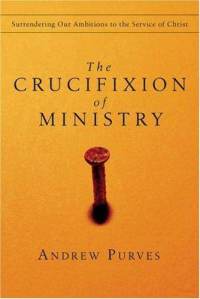
I'm reading " The Crucifixion of Ministry " by Andrew Purves (trinitarian theologian at Pittsburgh Theological Seminary; pictured at left). He urges us to reframe our view of ministry in light of the gospel of our inclusion in Christ. Rather than seeing ministry as "our ministry" we need to view it for what it truly is: a "sharing in the continuing ministry of Jesus Christ" (p. 11). This ministry is the work of the Father, in the Spirit, through Jesus for the sake of the church and all the world.   This view of ministry as participation in the ongoing ministry of Jesus flows from "the classical Christian doctrines of our participation through union with Christ in his vicarious humanity and ministry.... Because ministry is what Jesus does, ministry is properly understood as gospel rather than law and as grace rather then obligation.... The first and central question in thinking about ministry [in this way] is Who is Jesus Christ and what is he ...

Experiencing the Trinity

Image
I highly recommend the book  Experiencing the Trinity , by Darrell W. Johnson (associate professor of pastoral theology at Regent College in Vancouver, B.C.). Here is an excerpt from a review posted by the publisher: To many people the Trinity is a puzzle that is difficult, if not impossible, to assemble. We are challenged to comprehend the “one is three and three is one”-ness of it. By exploring the relationships within the Trinity, we learn that God the Father, God the Son, and God the Spirit are truly one God and yet are, at the same time, three distinct Persons. It is through the relationship of the three that the distinctions are revealed. It is by this Triune-relationship God that we are created; it is for this Triune-relationship God that we were created. Johnson writes of our inclusion in this Triune-relationship: The moment we say "yes" to Jesus, we are welcomed into the eternal inner circl...