Posts

The Incarnate Savior (Nicene Creed #6)

This post continues our series exploring the Nicene Creed (read other posts in the series by clicking a number:  1 , 2 , 3 , 4 , 5 , 7 , 8 , 9 ,  10 , 11 ,  12 ,  13 ). We come now to important words defining the Person and work of Jesus Christ: Who for us men and our salvation, came down from heaven, and was made flesh from the Holy Spirit and the Virgin Mary, and was made man and was crucified for us under Pontius Pilate. He suffered and was buried, and the third day he rose again according to the Scriptures and ascended into heaven, and sits on the right hand of God the Father. And he shall come again in glory to judge both the living and the dead; his kingdom shall have no end. A key point here is that our salvation is the act of God himself, who through the Incarnation... ...takes the concrete form of the actual historical man Jesus. As St Paul had expressed it: "God our Savior desires all men to be saved and to come to the  knowledge of the truth. Fo...

Nicene Creed video

Image
Here's a moving rendition of the Nicene Creed - a worshipful meditation with music. Enjoy! And for commentary on this important creed, click on the corresponding number of each post in a continuing series:  1 ,  2 ,  3 ,  4 , 5 .

Do we turn faith into a human work?

Image
We must avoid the tendency to see our faith as what saves us, thus turning faith into a human work. For a related discussion (with a powerful illustration), watch the excerpt below from a You're Included interview with trinitarian theologian Dr. Elmer Colyer.  Click here  for more You're Included interviews.

Jesus Christ, God's Son (Nicene Creed #5)

This post is part 5 in a series on the Nicene Creed . To read others, click on a number: 1 , 2 , 3 , 4 ,  6 ,  7 , 8 , 9 ,  10 , 11 ,  12 ,  13 . In this post, we'll examine the section in the creed concerning Jesus Christ, God's Son: [ We believe ] in one Lord Jesus Christ, the only begotten Son of God, begotten from his Father before all ages, Light from Light, true God from true God, begotten not made, of one being with the Father, through whom all things were made. Note how the creed defines Christ as  from his Father . In this eternal relationship, he is begotten   not made. The Father-Son relationship precedes any Creator-creature relationship. This, of course, was a key issue when the creed was written. All sorts of heretical ideas conceived of Jesus as some sort of creation of God rather than as true God . The creed shows such ideas to be false by asserting the biblical truth that Christ is the One through whom all things wer...

Can people get out of hell?

Image
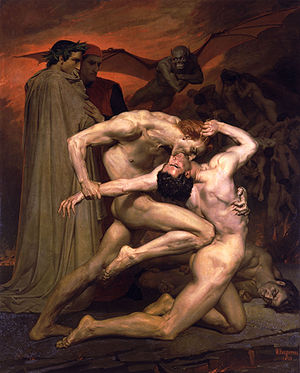
[Updated 7/25/2023] Can people get out of hell? To answer this question, we need to consider two others:  Is a person's fate determined permanently at death?  If not, on what basis might those in hell get out?  We'll address both questions in this post. "Dante and Virgil in Hell" by Bouquereau (public domain via Wikimedia Commons) Is a person's fate determined permanently at death? Many Christians answer "yes" to this question, typically citing Hebrews 9:27. In doing so, they understand this scripture to assert that upon death, a person is judged and the decision rendered at that time as to their eternal fate is then irreversible. However, in my view, using this passage in Hebrews to make that point is questionable. Note that the context of the verse is the universal scope of Jesus' substitutionary, atoning work, which he did "once for all" (Hebrews 9:26). He does not accomplish this work at some future time (such as some point p...

Father Almighty, our Creator (Nicene Creed #4)

This post is part 4 in a series that explores the Nicene Creed .  To read other parts, click on the corresponding number:  1 ,  2 ,  3 , 5 , 6 , 7 , 8 , 9 ,  10 , 11 ,  12 ,  13 . We come now to the section of the Creed that speaks of God the Father: One God the Father Almighty, Maker of heaven and earth and of all things visible and invisible. Here the Creed asserts that the one God, in the person of the Father Almighty,  is Creator ( Maker ) of all that is. As we noted in part two of this series, the Creed emphasizes that God is  one  in being (Gk= ousia ). Yet now the Creed begins to speak of the three persons of the one God, beginning with the Father, who as Almighty, is associated with his act of creating. This does not mean that the Father is Creator to the exclusion of the Son and Spirit. Rather (as noted by Tom Torrance in  The Trinitarian Faith), the Creed is granting "primacy to the concept of the Fatherhoo...

A Trinitarian, relational worldview

Image
How does one make sense of the world and God's relationship with it? These are always big questions, but of particular note as we remember 9/11. Though the video below does not address 9/11 specifically, it provides relevant insight. Jim Cantelon, a host of the Canadian program 100 Huntley Street , interviews L.T. Jeyachandran concerning how a trinitarian, relational theology informs L.T.'s understanding of the world. L.T. is an apologist and speaker who oversees the Singapore operations of Ravi Zacharias International Ministries . Food for thought (and feel free to comment)!

What can we sing at times like these?

This post was contributed by worship leader Mike Hale. Living on the West Coast of the U.S., I was up early to do business with my East Coast clients—including those in Manhattan, NY—and before leaving the house I usually checked email and national headlines. But the news that morning was anything but usual, as confusing headlines and horrifying pictures of one of the Twin Towers belching flames and black smoke sent me running to the bedrooms to wake my wife and our four grade school kids. Arriving in front of the TV, we were horrified to see the second tower explode into flames, as a jetliner hit it like a guided missile. As we stared in disbelief, the kids asked questions for which we had no answers. Actually, words were failing everyone—reporters, commentators, people on the streets—as events quickly unfolded to snuff out the lives of nearly 3000 souls from 90 countries, as suicide hijackers piloted four passenger airliners into the World Trade Center in New York City, the Pentag...

One God, the Father (Nicene Creed, #3)

This is part three of a series exploring the Nicene Creed . To read other parts, click on the corresponding number:  1 ,  2 ,  4 , 5 ,  6 , 7 , 8 , 9 ,  10 , 11 ,  12 ,  13 . Part 1 looked at the Creed's history, and part 2 looked at its opening phrase,  We believe.  Now we'll expand on that, looking at the longer phrase... We believe in one God, the Father...  The Creed was written to combat heresies infecting the fourth century church. Of particular concern was the dualistic idea that God (being spirit and thus transcendent), is necessarily separate from the material world, including humanity. This non-biblical worldview, which emerged out of pagan Greek philosophy, was embraced by some influential church leaders. As a result, some denied Jesus' humanity, while others (notably Arius of Alexandria) denied Jesus' divinity. Arius and others also denied that the Holy Spirit was a divine person. The Council ...

Will all be saved?

Image
[Updated 8/27/2019] Do Grace Communion Seminary and Grace Communion International (sponsors of this blog) teach a doctrine of universalism? The answer is no---both are in agreement with the teaching on this topic from Trinitarian theologian Thomas F. (TF) Torrance who notes that, "Whether all men will as a matter of fact  be saved or not, in the nature of the case, cannot be known" ( Scottish Journal of Theology 2 [1949] 310-18, quoted in In the End, God,  by John A.T. Robinson, Wipf and Stock: 2011, p. 148). Torrance offers two reasons for this assertion: 1) The irrational mystery of evil. 2) The truth that God gives each person the freedom to say "no" to him---potentially forever. Both reasons must be seen in the light of the deeper truth of God's election , which, in Torrance's view  TF Torrance expresses the universal action of God's grace in such a way that, far from dissolving the personal elements of choice and decision, it establishes ...

Is God's forgiveness conditional?

Image
Are there conditions that a person must meet in order for God to forgive them? Many answer yes , often making two claims: That God, being holy, stores up wrath against the sinner (here they typically cite Rom 2:5). Moreover, God will not  let go of this wrath, through forgiveness,  until the sinner repents (which to them, includes asking God for his forgiveness). That God will not forgive the sinner until they forgive those who have sinned against them (here they typically cite Jesus' words in Mat 6:14-15 and 18:21-35). I address the second claim in another post , so I'll focus here on the first. What I understand Scripture to teach (when read in the light of the gospel of grace), is that God's forgiveness of all humanity is unconditional and, moreover, has  already been granted. (public domain, Wikimedia Commons) First, let's note a disconcerting paradox: Those who claim that God will not forgive us until we repent, often claim that we should forg...

The journey with Jesus

In a recent You're Included   video ,  Dr. Alan Torrance beautifully and profoundly summarizes the Christian life as, "our sharing by the Spirit in the Incarnate Son's communion with the Father." As noted frequently in this blog, the Son of God, our Creator and Sustainer, united himself to all humanity by adding humanity to his divinity in the person of the God-man, Jesus Christ. Though not all people know of and thus personally experience this established union with Jesus, Christians do, and through the Holy Spirit they share actively in the Son's communion with his Father. Is their sharing perfect? No. Christians, like all human beings, are a work in progress. Therefore,I think it's helpful to think of this union leading to communion as a journey with Jesus . As I study Jesus' earthly life in Scripture, I see the journey as consisting of three basic steps (or, better yet, patterns of being and doing) that are grounded in and expressive of God's...

We believe (Nicene Creed, #2)

Image
This post is part 2 of a series exploring The Nicene-Constantinopolitan Creed (commonly called the Nicene Creed). For other parts, click on the corresponding number:  1 ,  3 ,  4 , 5 ,  6 , 7 , 8 , 9 ,  10 , 11 ,  12 ,  13 . This historic, orthodox Creed begins with a simple, yet profound assertion:          We believe...  The Creed defines the content of this belief in a way that has stood the test of time, being embraced by Christians of nearly every denominational stripe for over 1600 years! According to Athanasius, who was an influential delegate at Nicaea, the Creed sets forth "the divine and apostolic faith" (quoted in  The Trinitarian Faith by T.F. Torrance, p15). A ccording to Torrance, it presents the "simple first principles of the Gospel" (p16). The chief concern of the framers of the Creed, including Athanasius (see picture), was to clarify and defend what the Apostles taught concer...

Exploring the Nicene Creed (#1)

Image
This post is part 1 in an ongoing series that explores the Nicene-Constantinopolitan Creed (commonly called the Nicene Creed ). To read other posts in this series, click on the corresponding number:  2 ,  3 ,  4 , 5 ,  6 , 7 , 8 , 9 ,  10 , 11 , 12 , 13 . This series makes frequent reference to the book  The Trinitarian Faith by theologian Thomsas F. (T.F.) Torrance. Greek philosophy As Torrance notes (p2), the Nicene Creed represents the work of the Greek church fathers in reaching careful expression of crucial points in the Gospel where it had been seriously misunderstood and distorted under the influence of Greek philosophy. This philosophy viewed God as one, perfect, unchangeable and totally unlike physical beings. Such a perfect, unchanging God, they reasoned, would have nothing to do with physical matter, including with flawed human beings. The Arian Controversy Influenced by this Greek (Hellenized) philosophical view of  God, some...

Part 2: How one small church found its ‘worship voice’

This post was contributed by worship leader Mike Hale. Last time we began exploring the concept of God’s singing in the new life of believers as the ‘sound of the spiritual harvest’ (as described in The Sound of the Harvest , by J. Nathan Corbitt) and the need for a gathered group of such people to find th eir own ‘worship voice.’ But many observe there seems to be two completely different church ‘worlds’—there’s ‘big church’ and ‘little church’—and when it comes to music resources, they’re worlds apart. Mega churches have choirs, praise teams, bands, worship directors, staff, and celebrity worship leaders. But for small congregations with quite limited resources, it often means singing along to CDs or videos. So after some years of singing along to CD’s, here’s the story of how one little church prayerfully reevaluated their situation and decided to move in a different direction. The little flock had come to a crossroads of sorts, and needed to address a number of challenges. In s...

What is the center of the Christian message?

Image
Bishop Ware The July 2011 issue of Christianity Today features an interview conducted by CT editor-in-chief David Neff with Bishop Kallistos Ware of the Greek Orthodox Church ( click here to read the article, and here  for a video). In answer to Neff's question, What is the center of the Christian message? , Ware states the following: I believe in a God who loves humankind so intensely, so totally, that he chose himself to become human. Therefore, I believe in Jesus Christ as fully and truly God, but also totally and unreservedly one of us, fully human...  The love of God is so great that Christ died for us on the cross. But love is stronger than death, and so the death of Jesus was followed by his resurrection. I am a Christian because I believe in the great love of God that led him to become incarnate, to die, and to rise again. That's my faith. All of this is made immediate to us through the continuing action of the Holy Spirit (p41). Note the Trinitarian framework a...

Part 1: Finding our worship voice – the sound of the harvest

This post was contributed by worship leader Mike Hale. When it comes to congregational singing, some of the best advice I've ever heard is that each congregation needs to find it’s own collective ‘worship voice’. In other words, it is important for each unique collection of humanity to discover the music, songs, instrumentation and methods that best enable the offering of thanks, praise, and testimony in that particular setting. Through Christ and the Spirit, the Triune God has entered into creation and the life story and relationships of each individual and group. So, yes, there is unity in Christ. But because of unique individual, family, cultural and congregational relationships and histories, each collective ‘worship voice’ will not sound identical to a ‘worship voice’ in another setting, though each sings the common, yet ever-new song of redeeming love, an echo of the New Song of the Lamb in the heavenly realm. This ‘worship voice’ of gathered humanity is not static, but l...

Beware exclusivism!

Image
John Wesley Trinitarian, incarnational theology teaches that God the Father has included all people in his love and life, through the person and work of his incarnate Son Jesus Christ, in the power of the Holy Spirit. How ironic (and sad) if those who embrace this theology of inclusion  would express an attitude of exclusivism ! I was thinking about this (and examining my own attitude), when I watched the movie Wesley . It dramatizes the story of the life and ministry of John Wesley and his brother Charles. John and Charles were highly educated (both grads of Oxford U.). However, part of the genius of their Methodist movement was the ability to recognize that the Holy Spirit is able to further the cause of Christ through common, often uneducated (and sometimes even ill-informed) people serving as teachers and preachers. Though the Wesley's valued and advocated higher education and sound theology, they realized that perfection in these matters is not the end-all and be-a...

Male and female as the image of God

God created man in his own image, in the image of God he created him; male and female he created them  (Genesis 1:27). According to Frances and Paul Hiebert, the humanity that images God is a  co-humanity  constituted by men and women in relationship. Stated negatively, men alone and women alone do not express fully the image of God   (see the Hiebert's essay,  The Whole Image of God: A Theological and Anthropological Understanding of Male-Female Relationship,  in Incarnational Ministry ,  edited by Kettler and Speidell). This makes sense in light of the biblical revelation that our triune God is a relational communion of three persons (Father, Son and Holy Spirit), in which there is unity, diversity (distinction of persons) and equality . God's communitarian nature is imaged in humanity when a similar unity, diversity and equality are found in us - particularly in our male-female relationships. According to the Hieberts, differing male and ...