Posts

The rich meaning of Jesus' cry of dereliction

Image
In Wounds that Heal, Bringing Our Hurts to the Cross ,  Stephen Seamands (Professor at Asbury Theological Seminary) writes that disappointment with God is common to believers who, having experienced trauma, were left wondering, "Where was God?" "Why did God let this terrible thing happen to me?"  Crucifixion   by Emil Nolde (1912) (source:  https://modernistarthistory.blogspot.com/2015/01/22.html ) In helping us understand and deal with these difficult, challenging questions, and the resultant feelings of disappointment with God, Seamands reminds us that  Jesus himself felt disappointment, even abandoned by God. After being suspended [on the cross] for six hours, he finally voiced his disappointment.... He cried out "with a loud voice, 'Eloi, Eloi, lema sabachthani? ' (Mark 15:34). In Aramaic... Jesus was reciting a familiar verse, Psalm 22:1: "My God, My God, why have you forsaken me?" In his bitter cry of dereliction, he made those words his...

How are we to understand Genesis 1:2?

Image
And the earth was a formless and desolate emptiness, and darkness was over the surface of the deep, and the Spirit of God was hovering over the surface of the waters . (Genesis 1:2, NASB) How are we to understand this verse? Many commentators note that it has much in common with the creation epics (myths) of the Ancient Near East (ANE). However, Torrance scholar Dr. John McKenna, in his essay "Reading Genesis 1:2," argues that this interpretive approach is inadequate. What follows is quoted from his essay (with minor edits) with permission from John's heirs. Chaos by Aivazovsky (public domain via Wikimedia Commons) The willingness to divorce our understanding of chaos, emptiness, darkness, and the deep of the faces of the waters, with which the Spirit of God is said to ' be brooding' in [Gen. 1:2], belongs to a pre-suppositional framework of thought developed in an epistemological split between Dogmatic and Biblical Theologians in our times, when modern exegesis b...

Is there an "order of salvation"?

Image
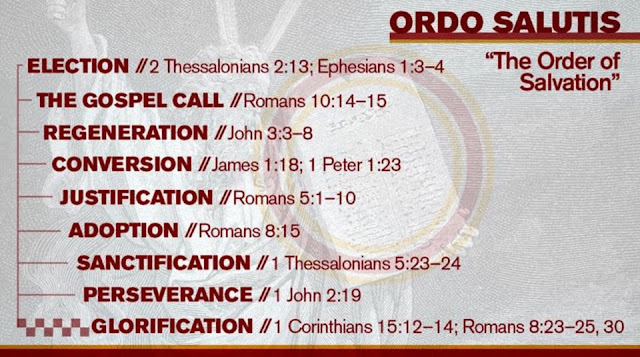
Some Christians teach what is called an "order of salvation" (Latin: "ordo salutis") which, as seen in the sample pictured here, sets forth salvation as a "process"--an ordered sequence of "steps." This post offers a critique of that conception of salvation from Karl Barth and Al Kimel. Those who believe that the Bible teaches that salvation can be reduced to an ordo salutis typically cite as evidence various passages of Scripture (as in the diagram), including this one: For those God foreknew he also predestined to be conformed to the image of his Son, that he might be the firstborn among many brothers and sisters. And those he predestined, he also called; those he called, he also justified; those he justified, he also glorified.  (Romans 8:29-30) Is Paul here outlining sequential steps in a linear "process" of salvation? Barth and Kimel [1] say no. Read on.  Karl Barth's view In a recent Karl Barth Discussion Group post, theologia...

Has the Son of God always been incarnate?

Image
This post draws on the teaching of Thomas F. (TF) Torrance in explaining that the incarnation (like the creation) was something 'new' to God, though it was purposed by God from all eternity.   Let's begin with Dr. Gary Deddo's summary of TF's thought on this topic. The quote below is from an email Gary sent me, to which I've added bold face to emphasize key points. "TF strongly and repeatedly affirmed that the incarnation, like the creation, is something 'new' to God. The Son of God was not always incarnate ---the human nature Jesus assumed upon his incarnation was a created human nature, which did not exist from eternity. God alone is eternal. This understanding is backed up by the biblical teaching that creation was ex nihilo (out of nothing). There was not a human person prior to creation. "However, we can and probably should say that God anticipated in some eternal way both the creation and the incarnation. What God did to bring creation a...

Are science and theology hopelessly at odds?

Image
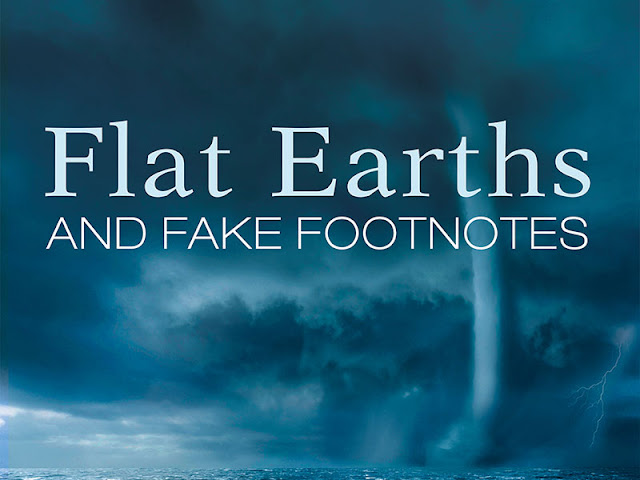
This post takes a brief look at Flat Earths and Fake Footnotes, the Strange Tale of How the Conflict of Science and Christianity Was Written Into History   by Derrick Peterson, adjunct professor at Multnomah University and Seminary. As Peterson demonstrates, there remains within modern culture (both secular and religious circles) the false narrative that science and theology are hopelessly at odds. Calling this narrative the warfare thesis , Peterson asks, "Where did it come from? How did it take hold? What myths were used, and why? How was it uncovered and eventually overturned in academia? (p. ix). Peterson answers these and related questions in this eye-opening book. In doing so, he refutes the secularized, sanitized, theology-deleting accountings of the scientific revolution, arguing that Christianity made significant contributions to that revolution, which in turn contributed to the development of Western civilization. He notes that at the time of the scientific revolutio...

Introduction to T.F. Torrance's theology (part 4): Theological Concepts

Image
This post concludes a series exploring  T.F. Torrance in Recollection and Reappraisal   by Bruce Ritchie. For other posts in the series, click a number:  1 ,  2 , 3 . Last time , we looked at Torrance's theological method, which he refers to as  theological science. This time we'll conclude the series by looking at several of T.F.'s  theological concepts. Though understanding Torrance is a challenge, his teachings become clearer when these concepts are grasped. The first one picks up where we concluded last time: 1. Approach theology as a scientific discipline  We begin with T.F.'s core conviction that, rightly practiced, theology is an objective scientific discipline, meaning that "it allows its object (God) to determine the appropriate mode of enquiry" (p. 83). Ritchie comments on his personal awakening to this important principle: Once I understood... so much else fell into place. To think scientifically is to think in accordance with the natur...

Setting the Spiritual Clock, part 2

Image
This post concludes a two-part series highlighting key points in Paul Louis Metzger's book " Setting the Spiritual Clock: Sacred Time Breaking Through the Secular Eclipse ." For the first post,  click here . Last time  we looked at Metzger's introduction to the Christian worship calendar, and his analysis of Advent and Christmastide, the first two seasons in the liturgical year. In this post I highlight what he writes concerning other primary festivals and seasons, beginning with Epiphanytide, in which Christians celebrate the great truth that, in Christ, God is with us. "The Adoration of the Magi" by Edward Burne-Jones (public domain via Wikimedia Commons) Epiphanytide: God is with us The festival day known as Epiphany (or sometimes The Epiphany ) and the season it begins, known as Epiphanytide , are about the revealing of Jesus to the world. The English word epiphany, from the Greek word epipháneia  (meaning manifestation or appearance) is used in several ...

Trinitarian theology of church and mission

Image
This post is from Dr. Randy Bloom, Board chair and faculty member at Grace Communion Seminary. Though we may be inconsistent at times, we generally live according to what we believe. Theology has a similar influence in our lives, both personally and collectively as the church. Theology–the beliefs and concepts that attempt to express, in Biblically informed human terms, God’s being and actions–influences all we do.  "Come and See" by Liz Lemon Swindle (used with artist's permission) Theological framework for mission Beliefs affect actions. Theology, what we believe about God, gives direction to life decisions, ministry motivation, goalsetting, and planning. In other words, theology informs and directs the mission of the church. Mission answers the “What?” question regarding the church, i.e., mission explains what the church is to be doing (loving people, preaching the gospel, making disciples, equipping people for ministry, etc.).  Theology answers the “Why?” question. Wh...

Beyond a Clockwork Universe

Image
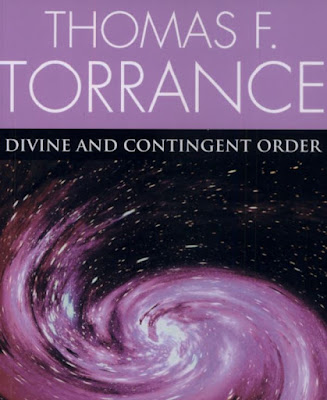
  This post is from Neil Earle who teaches Christian History at Grace Communion Seminary. Though the Universe reflects the rationality of its Creator, it has surprise factors built into it . Powerful insights like this  animated the observations of Trinitarian theologian Thomas F. Torrance in applying the insights of scientific discovery to what he knew about the Triune God. He especially explored the startling implications of what was called the "New Physics” of the early 1900s--the work of Planck, Einstein and Bohr, in particular. Across a distinguished academic career, Torrance advanced the themes of the openness of the created order to newness and new creations . By some estimates, 10,000,000 new suns have been created since homo sapiens emerged, using the conventional phraseology. The latest pictures from deep space show colorful but eruptive patterns that either reflect faraway explosions or new star systems coming into existence. “Rationality and surprise” in Torrance’s...