Posts

How To Be a Gospel-Shaped Church (preaching resource for Advent 3, December 17, 2023)

Image
This post exegetes 1 Thessalonians 5:12-28, providing context for the RCL Epistle reading for 12/17/2023 (third Sunday of Advent). This exegesis draws on John Stott's commentary. Early Christian Worship in the Catacombs (public domain via Wikimedia Commons) Introduction   In the second half of 1 Thessalonians chapter 5, the apostle Paul calls on the church to strengthen their life together as 'brothers' in the family of God. He does so by addressing three vital aspects of gospel-shaped Christian community: the church's leadership, the church's fellowship, and the church's worship.  The church's leadership  1 Thessalonians 5:12-13 Jesus Christ, the Chief Shepherd, delegates to under-shepherds ('pastors') the oversight of the flock which Jesus bought with his own blood (Acts 20:28). We do not know what prompted Paul to write verses 12 and 13. Perhaps some church members had been disrespectful towards their leaders. Perhaps some leaders provoked this re...
The Day of the Lord (preaching resource for Advent 2, December 10, 2023)

Image
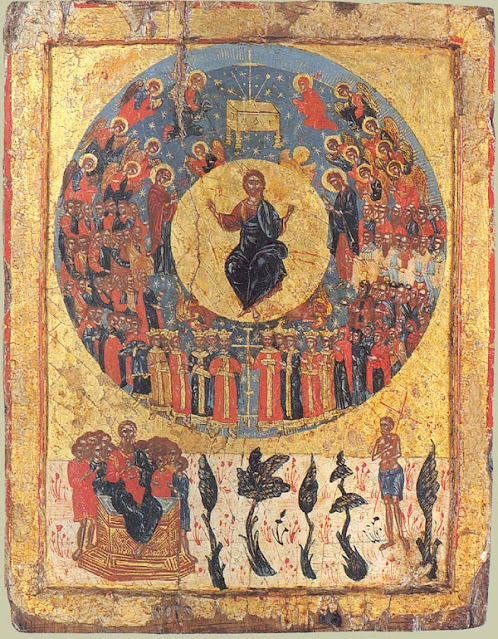
This post exegetes 2 Peter 3, providing context for the RCL Epistle reading for 12/10/2023 (the second Sunday of Advent). It draws on commentary from from Warren Wiersbe ("Bible Expository Commentary") and David Wheaton ("New Bible Commentary"). Icon: Second Coming (via Wikimedia Commons) Introduction  Already in this second epistle of Peter, the apostle has characterized the false teachers troubling the churches in Asia Minor as “arrogant” (2Pet 2:10b) heretics (2Pet 2:1). They are an “accursed brood” (2Pet 2:14b) of blasphemers (2Pet 2:12a). They are also “unreasoning animals” (2Pet 2:12b); “blots and blemishes” (2 Pet 2:13b) who are “slaves of depravity” (2Pet 2:19). And now Peter adds another charge—they are “scoffers” who pursue “their own evil desires” (2Pet 3:3). In their scoffing, they “willingly forget” (2Pet 3:5) God’s word concerning the judgment that will accompany Jesus’ return (2Pet 1:16, 3:13). Peter scoffs right back at them, reminding us all of thre...

Signs of the End (preaching resource for Advent 1, December 3, 2023)

Image
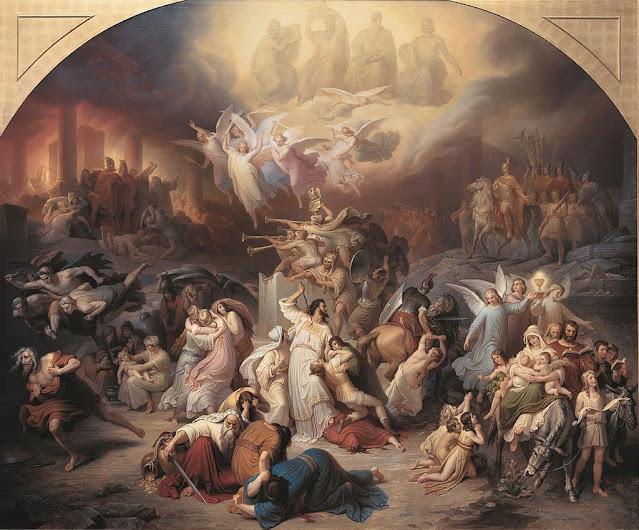
This post exegetes Mark 13:1-37 to provide context for the RCL Gospel reading for 12/3/2023 (the first Sunday of Advent). It draws on commentary from Alan Cole ("New Bible Commentary") and John Grassmick ("Bible Knowledge Commentary"). "Titus Destroying Jerusalem" by Kaulbach (public domain via Wikimedia Commons)  Introduction In Mark 13:1-37, the evangelist recounts the warning that Jesus gave his inner circle concerning the judgment about to come upon the people of Jerusalem and Judea due to their rejection of Jesus and his Kingdom. This judgment will be a time of testing for Jesus’ inner circle of disciples.  The subject is introduced by the prophecy of judgment on the temple (Mark 13:2). Jesus’ disciples probably believe that destruction of the temple means the end of the age, and thus they are anxious know the signs (Mark 13:3-4). But Jesus’ answer essentially avoids the issue of timing, though in Mark 13:3 he tells them that these terrible things wil...

Jesus' Grace-based Judgment, part 4 (preaching resource for Nov. 19 and 26, 2023)

Image
This post exegetes Matthew 25:14-46 to provide context for the RCL Gospel readings for 11/19 and 11/26 of 2023 (24th and 25th Sundays after Pentecost). It draws on commentary from Robert Capon ("Kingdom, Grace, Judgment"), RT France ("New Bible Commentary") and Louis Barbieri ("Bible Knowledge Commentary").  This post is part of a four-part series; to access the other parts, click a number:  1 ,  2 , 3 . Introduction In this post we continue looking at the section of the Gospel of Matthew spanning 24:36-25:46 in which Jesus addresses the part of the last days that began in AD 70 then stretches to his appearing ( parousia ) at the end of the age. In 25:14-46, Jesus elaborates on that time with two additional parables focused on the salvation and judgment that result from his presence.   Be serving: The parable of the talents (25:14-30) 14 "Again, it [the kingdom of heaven] will be like a man going on a journey, who called his servants and entrusted hi...

The Lord's Prayer: living in the kingdom of God

Image
What is the kingdom of God? For many Christians, the term "kingdom of God" brings to mind the transformation of the world that will occur when Jesus returns to earth. In other words, they think of the kingdom as yet future. Those who hold this view diminish or entirely overlook the biblical teaching that the kingdom is now present.  Note the definition of the kingdom offered by Gary Deddo in an  essay  on the Grace Communion Seminary website: The kingdom of God is primarily about the rule or reign of Christ and not so much…about a realm or a spatial or geographical location. Wherever Christ’s lordship is operating according to his will and purpose, there is found the kingdom of God. Note also how Grace Communion International's catechism “ We Believe ” defines the kingdom: In the broadest sense, the kingdom of God is God's supreme sovereignty—his reign over all the world through the operation of the Holy Spirit based on the completed work of Jesus Christ. That reign i...

Finding our way back: fall, redemption, glorification

Image
Fundamental to the historic, orthodox Christian faith (biblical theism) is the understanding that God created humanity in his own image. A related understanding is that what was given humanity at creation was in some way lost or at least greatly diminished as a consequence of the Fall . But the good news is that there is a solution — there is a way back: redemption  and ultimately glorification . "Expulsion from the Garden of Eden" by Masaccio (public domain via Wikimedia Commons) In The Universe Next Door   (5th edition, 2009), James W. Sire describes the consequences of the Fall and what God is doing to reverse its effects:  Human beings were created good, but through the Fall the image of God became defaced, though not so ruined as not to be capable of restoration. Through the work of Christ, God redeemed humanity and began the process of restoring people to goodness, though any given person may choose to reject that redemption. (38-39) Sire notes that by rebelling aga...

Jesus' Grace-based Judgment, part 3 (preaching resource for Nov. 12, 2023)

Image
This post exegetes Matthew 25:1-13 to provide context for the RCL Gospel readings for 11/12/2023 (24th Sunday after Pentecost). It draws on commentary from Robert Capon ("Kingdom, Grace, Judgment"), RT France ("New Bible Commentary") and Louis Barbieri ("Bible Knowledge Commentary").  This post is part of a four-part series; to access the other parts, click a number:  1 , 2 ,  4 . Introduction In Matthew 24:36-25:46 Jesus addresses the part of the last days that began in AD 70 and then stretch to his appearing ( parousia )   at the end of the age. Jesus makes his points with parables focused on the salvation and judgment that result from his presence—now in the Spirit, and yet to come in the Great Consummation that will occur when he appears bodily in glory. In the parable of the faithful and bad servants (Matt. 24:36-51), Jesus addresses the parousia, noting that it will occur when not expected because its timing   is unknown. That being the case, it is c...

Jesus' Grace-based Judgment, part 2 (preaching resource for Oct. 22, 29 and Nov. 5 in 2023)

Image
This post exegetes Matthew 22:15-23:39, providing context for the RCL Gospel readings on Oct. 22, 29 and Nov. 5 in 2023 (21st, 22nd and 23rd Sundays after Pentecost). This exegesis draws on commentary from Robert F Capon ("Kingdom, Grace, Judgment"), RT France ("New Bible Commentary"), and Louis Barbieri ("Bible Knowledge Commentary").  This post is part of a four-part series; to access the other parts, click a number: 1 ,  3 ,  4 . Introduction Last time  we looked at the first part of the Holy Week confrontations between Jesus and the Jewish religious establishment. We’ll now look at additional ones. Throughout, Jesus uses these confrontations to reveal more about his identity as the Messiah, the Son of God; and about the radical nature of the grace and judgment that comes in and through him. "Woe Unto You Scribes and Pharisees" by Tissot (public domain via Wikimedia Commons) Confronting the Jewish religious establishment (22:15-22:46) The Jewi...